2023 AP Statistics Free-Response Questions
Advanced PlacementAP StatisticsFree ResponseMathematics
6 questions24 pts
6 gradable6 rubric criteria0 dependencies
q1Question 1
q1
Question 1
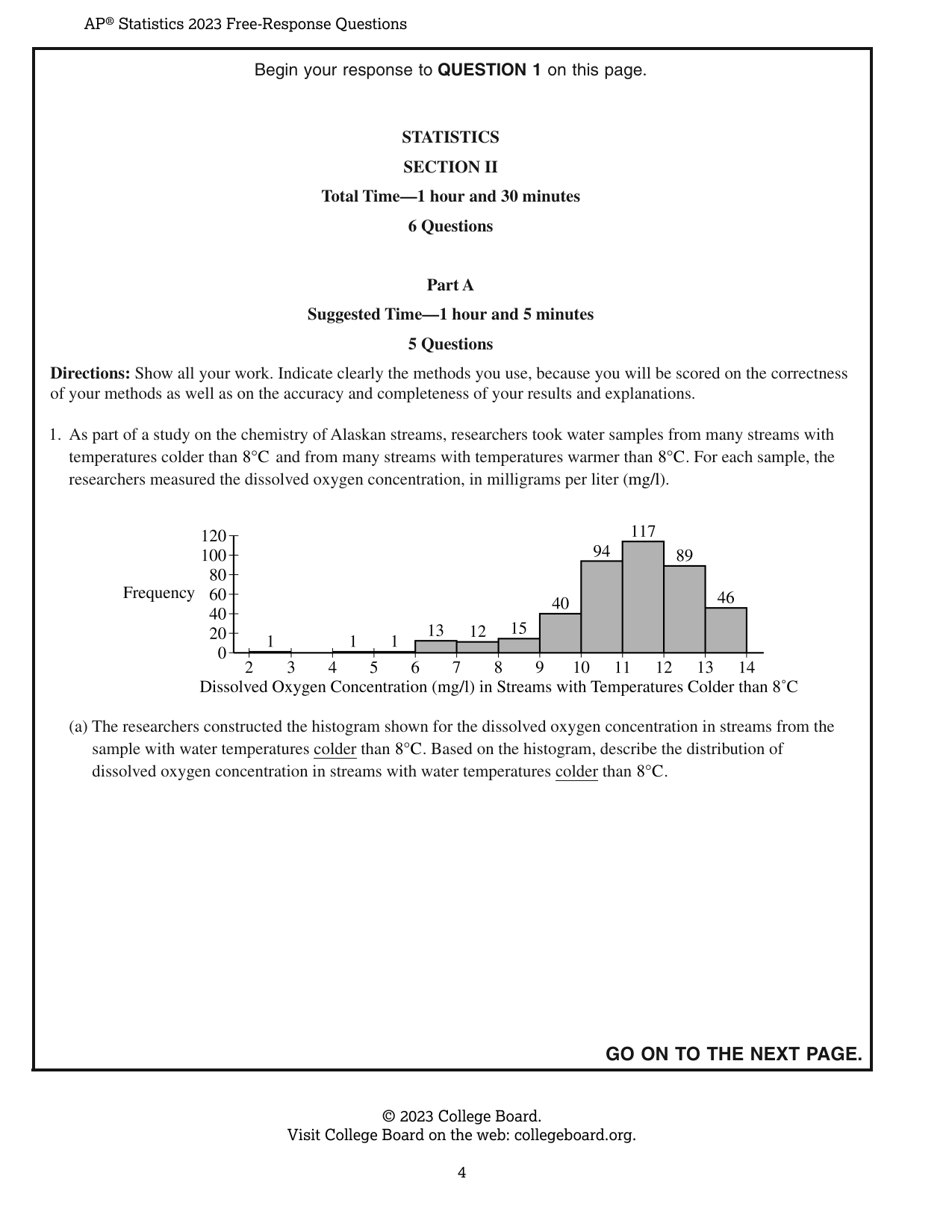
Directions: Show all your work. Indicate clearly the methods you use, because you will be scored on the correctness of your methods as well as on the accuracy and completeness of your results and explanations. 1. As part of a study on the chemistry of Alaskan streams, researchers took water samples from many streams with temperatures colder than 8°C and from many streams with temperatures warmer than 8°C. For each sample, the researchers measured the dissolved oxygen concentration, in milligrams per liter (mg/l). The histogram shows the dissolved oxygen concentration (mg/l) in streams with temperatures colder than 8°C. The frequencies shown are: 2–3: 1; 4–5: 1; 5–6: 1; 6–7: 13; 7–8: 12; 8–9: 15; 9–10: 40; 10–11: 94; 11–12: 117; 12–13: 89; 13–14: 46. (a) The researchers constructed the histogram shown for the dissolved oxygen concentration in streams from the sample with water temperatures colder than 8°C. Based on the histogram, describe the distribution of dissolved oxygen concentration in streams with water temperatures colder than 8°C. For the dissolved oxygen concentration in streams from the sample with water temperatures warmer than 8°C, the researchers computed the following summary statistics: | Min | Q1 | Median | Q3 | Max | Mean | Std. Dev. | |---|---|---|---|---|---|---| | 2.10 | 4.39 | 5.43 | 6.12 | 13.45 | 5.54 | 1.64 | (b) The researchers computed the summary statistics shown in the table for the dissolved oxygen concentration in streams from the sample with water temperatures warmer than 8°C. Use the summary statistics to construct a box plot for the dissolved oxygen concentration in streams with water temperatures warmer than 8°C. Do not indicate outliers. (c) The researchers believe that streams with higher dissolved oxygen concentration are generally healthier for wildlife. Which streams are generally healthier for wildlife, those with water temperature colder than 8°C or those with water temperature warmer than 8°C? Using characteristics of the distribution of dissolved oxygen concentration for temperatures colder than 8°C and characteristics of the distribution of dissolved oxygen concentration for temperatures warmer than 8°C, justify your answer.
Rubric Criteria (1)
C1Holistic score for Question 1, awarded from 0 through 4. For part (a), rate E when the response includes context of dissolved oxygen concentration and at least three of: skewed-left shape; center between 11 and 12 mg/l; a spread measure supported by the rubric (range 10–12 mg/l, all values between 2 and 14 mg/l, or IQR 1.5–2.5 mg/l); and potential outliers or a gap between 3 and 4 mg/l. Approximate center values must be between 11 and 12 mg/l inclusive; approximate range, IQR, and standard deviation values must be within the stated bounds. A normal description cannot satisfy shape, definitive outlier language cannot satisfy unusual features, and incorrect interval language does not satisfy spread. Rate P when context plus two of the four descriptive components is present, or when at least three of the four components are present without context; otherwise I. For part (b), rate E when the response is a boxplot with four or five of: box beginning at Q1, box ending at Q3, median inside the box, lines extending to the minimum, and lines extending to the maximum. Rate P for a boxplot with exactly three components; a non-boxplot is I. Correct placement requires minimum 2–2.5, Q1 4–4.5, median 5–5.5, Q3 6–6.5, and maximum 13–13.5. For part (c), rate E when the response states colder streams are healthier and includes at least two of: directly compares centers; identifies warmer streams as right-skewed and colder streams as left-skewed; directly compares spreads. The model values are colder median 11–12 mg/l versus warmer median 5.43 mg/l, and similar IQRs of approximately 2 mg/l and 1.73 mg/l. Rate P when the health statement plus one comparison is present; otherwise I. A response based on an earlier incorrect part may receive E or P if internally consistent. Question score: 4 for three E parts; 3 for two E and one P; 2 for two E and no P, one E plus one or two P, or three P; 1 for one E and no P or no E and two P; otherwise 0.
4.0000pts
Dependencies (0)
Page Mapping (2)
Visual Preview
4 boxes
Draw, drag, resize. Advanced coordinates are available if needed.
1
2
3
4
Select a box to edit its role and metadata.
Attribution
This material is the intellectual property of College Board, is not owned by GradeThis, and is shown here for ease of use and demonstration purposes.