2023 AP Calculus BC Free-Response Questions
Advanced PlacementAP Calculus BCFree ResponseMathematics
6 questions54 pts
6 gradable54 rubric criteria0 dependencies
q1Question 1
q1
Question 1
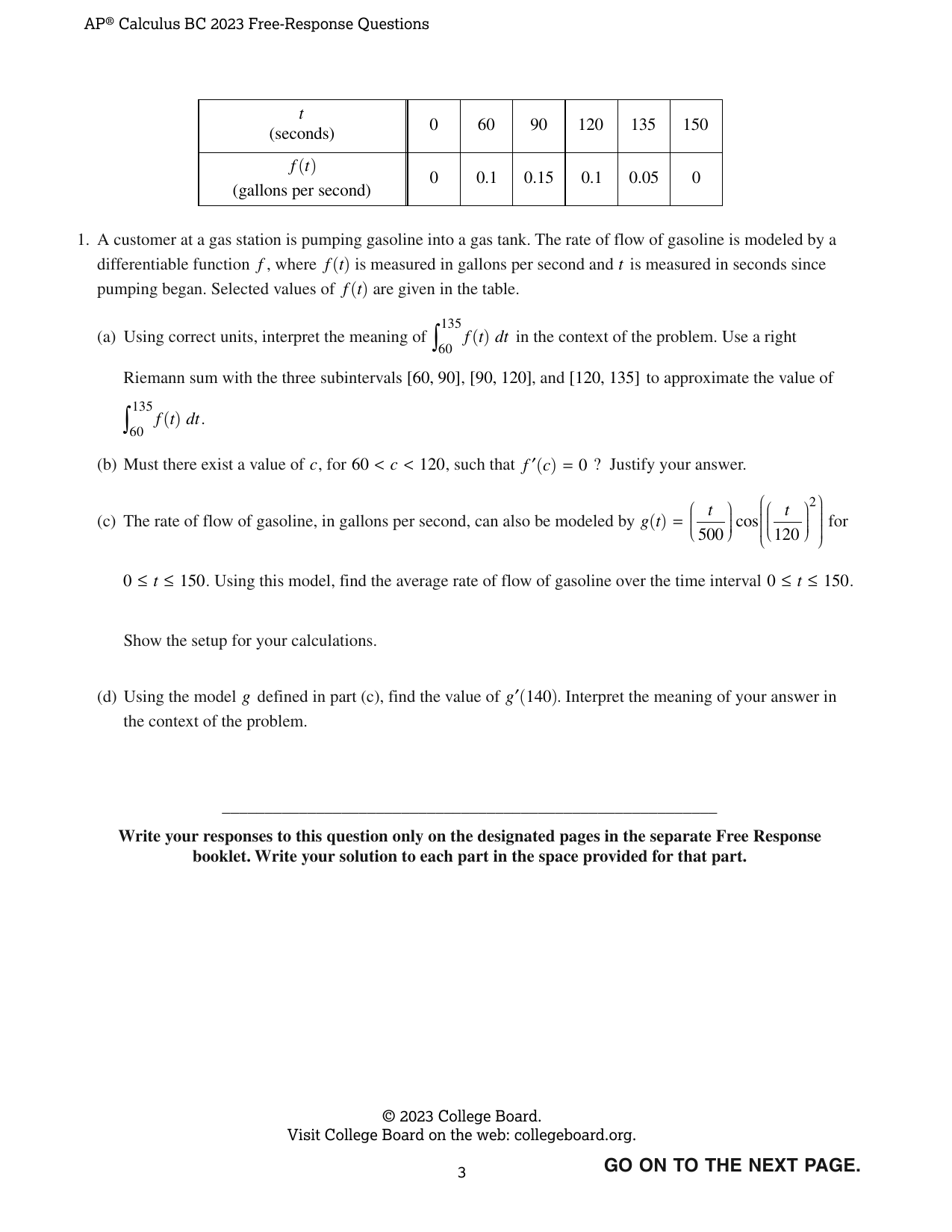
t (seconds) 0 60 90 120 135 150 f(t) (gallons per second) 0 0.1 0.15 0.1 0.05 0 1. A customer at a gas station is pumping gasoline into a gas tank. The rate of flow of gasoline is modeled by a differentiable function f, where f(t) is measured in gallons per second and t is measured in seconds since pumping began. Selected values of f(t) are given in the table. (a) Using correct units, interpret the meaning of $\int_{60}^{135} f(t)\,dt$ in the context of the problem. Use a right Riemann sum with the three subintervals [60, 90], [90, 120], and [120, 135] to approximate the value of $\int_{60}^{135} f(t)\,dt$. (b) Must there exist a value of c, for $60<c<120$, such that $f'(c)=0$? Justify your answer. (c) The rate of flow of gasoline, in gallons per second, can also be modeled by $g(t)=\left(\frac{t}{500}\right)\cos\left(\left(\frac{t}{120}\right)^2\right)$ for $0\le t\le 150$. Using this model, find the average rate of flow of gasoline over the time interval $0\le t\le 150$. Show the setup for your calculations. (d) Using the model $g$ defined in part (c), find the value of $g'(140)$. Interpret the meaning of your answer in the context of the problem. Write your responses to this question only on the designated pages in the separate Free Response booklet. Write your solution to each part in the space provided for that part.
Rubric Criteria (9)
C1The response interprets $\int_{60}^{135} f(t)\,dt$ as the total number of gallons of gasoline pumped into the gas tank from time $t=60$ seconds to time $t=135$ seconds, referencing both the quantity (gallons) and the time interval.
1.0000pts
C2The response presents a right Riemann sum using the subintervals $[60,90]$, $[90,120]$, and $[120,135]$ that contains at least five of the six correct factors, or presents the three correct products $(0.15)(30)+(0.1)(30)+(0.05)(15)$; a completely correct left Riemann sum with accompanying work also earns this point.
1.0000pts
C3The response gives the correct value $8.25$ (or equivalent) for the right Riemann sum approximation, supported by work that shows either all six factors, the three correct products, or the equation $f(90)(30)+f(120)(30)+f(135)(15)=8.25$; an answer of only $8.25$ with no supporting work does not earn this point.
1.0000pts
C4The response presents $f(120)-f(60)=0$, $0.1-0.1=0$ (as a numerator or difference), or $f(60)=f(120)$.
1.0000pts
C5The response answers that there is such a $c$ ("yes" or equivalent), states that $f$ is continuous on $[60,120]$ because $f$ is differentiable (or equivalent), and references the Mean Value Theorem or Rolle's Theorem.
1.0000pts
C6The response presents the average value formula $\frac{1}{150}\int_0^{150} g(t)\,dt$ (or equivalent correct setup for the average rate of flow over $0\leq t\leq 150$).
1.0000pts
C7The response gives the average rate of flow as approximately $0.096$ (or $0.095$ or $0.0959967$) or as the exact equivalent $\frac{12}{125}\sin\left(\frac{25}{16}\right)$.
1.0000pts
C8The response presents a numerical value for $g'(140)$, such as approximately $-0.004908$, $-0.005$, or $-0.004$ (or exact equivalent).
1.0000pts
C9The response interprets the numerical value of $g'(140)$ as the rate at which the rate of flow of gasoline is changing at $t=140$ seconds, using the declared value and correct units, and correctly states that the flow is decreasing when the value is negative.
1.0000pts
Dependencies (0)
Page Mapping (1)
Visual Preview
7 boxes
Draw, drag, resize. Advanced coordinates are available if needed.
1
2
3
4
5
6
7
Select a box to edit its role and metadata.
Attribution
This material is the intellectual property of College Board, is not owned by GradeThis, and is shown here for ease of use and demonstration purposes.