2025 AP Calculus AB Free-Response Questions
Advanced PlacementAP Calculus ABFree ResponseMathematics
6 questions54 pts
6 gradable54 rubric criteria0 dependencies
q1Question 1
q1
Question 1
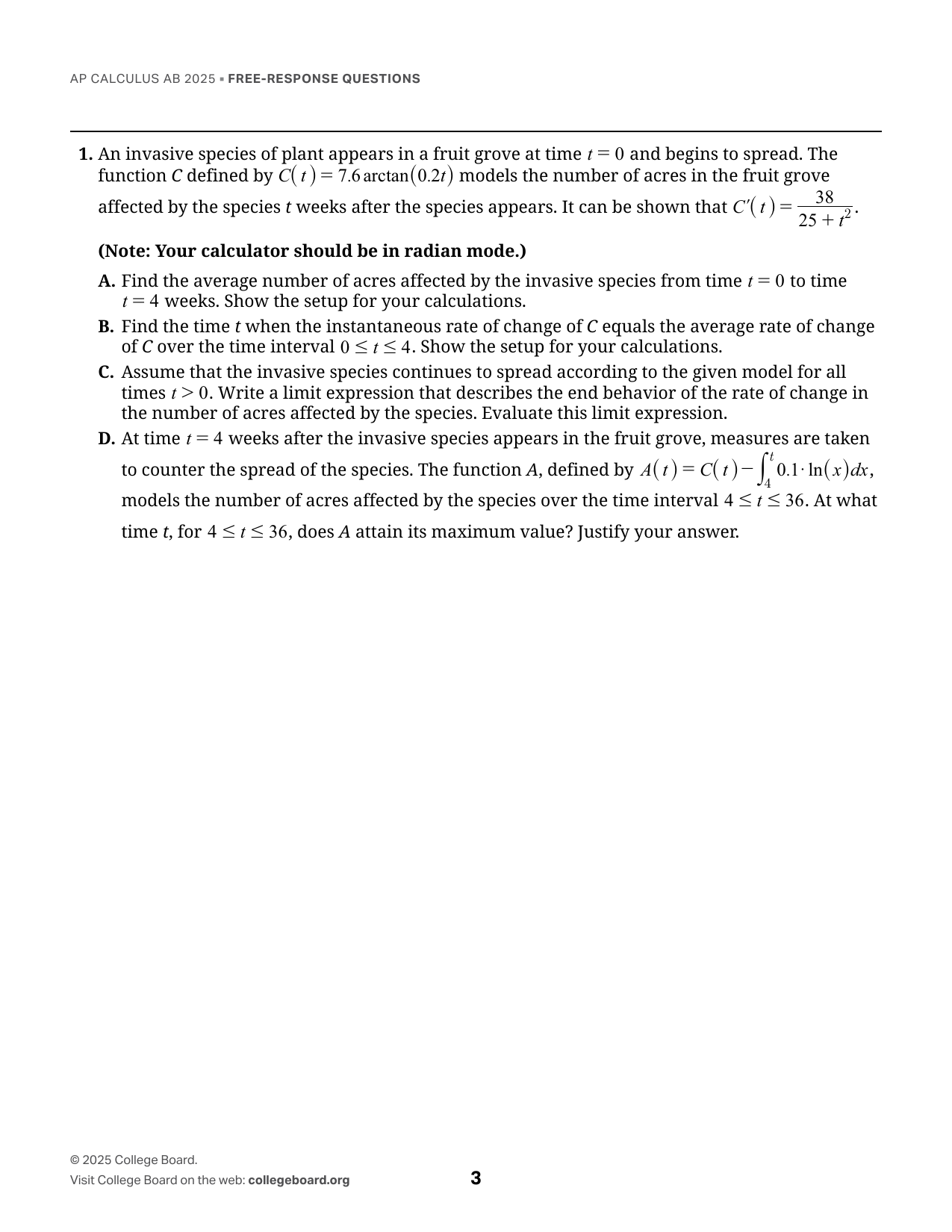
1. An invasive species of plant appears in a fruit grove at time t = 0 and begins to spread. The function C defined by C(t) = 7.6 arctan(0.2t) models the number of acres in the fruit grove affected by the species t weeks after the species appears. It can be shown that C'(t) = 38/(25 + t²). (Note: Your calculator should be in radian mode.) A. Find the average number of acres affected by the invasive species from time t = 0 to time t = 4 weeks. Show the setup for your calculations. B. Find the time t when the instantaneous rate of change of C equals the average rate of change of C over the time interval 0 ≤ t ≤ 4. Show the setup for your calculations. C. Assume that the invasive species continues to spread according to the given model for all times t > 0. Write a limit expression that describes the end behavior of the rate of change in the number of acres affected by the species. Evaluate this limit expression. D. At time t = 4 weeks after the invasive species appears in the fruit grove, measures are taken to counter the spread of the species. The function A, defined by A(t) = C(t) − ∫₄ᵗ 0.1 · ln(x) dx, models the number of acres affected by the species over the time interval 4 ≤ t ≤ 36. At what time t, for 4 ≤ t ≤ 36, does A attain its maximum value? Justify your answer.
Rubric Criteria (9)
P1Presents the average-value setup \(\frac{1}{4}\int_0^4 C(t)\,dt\), or an equivalent definite integral together with evidence of division by 4.
1.0000pts
P2States that the average number of acres affected from \(t=0\) to \(t=4\) is \(2.778\) acres, or an equivalent value accurate to three decimal places by rounding or truncation.
1.0000pts
P3Presents the average rate of change of \(C\) on \([0,4]\) as \(\frac{C(4)-C(0)}{4-0}\), or an equivalent expression or value such as \(\frac{C(4)}4\) or \(1.282008\).
1.0000pts
P4Uses an equation equating the instantaneous rate \(C'(t)=\frac{38}{25+t^2}\) to the average rate of change and obtains \(t=2.154\) weeks, or an equivalent value accurate to three decimal places.
1.0000pts
P5Writes a limit expression describing the end behavior, such as \(\lim_{t\to\infty}C'(t)=\lim_{t\to\infty}\frac{38}{25+t^2}\) or \(\lim_{t\to\infty}C(t)\).
1.0000pts
P6Evaluates the limit of the rate of change as \(0\), without relying solely on arithmetic expressions involving infinity.
1.0000pts
P7Considers a critical point for \(A\) by setting \(A'(t)=0\), equivalently \(C'(t)-0.1\ln t=0\) or \(C'(t)=0.1\ln t\), or discusses a sign change of \(A'\).
1.0000pts
P8Justifies the global maximum on \(4\le t\le36\) by correctly evaluating \(A\) at \(t=4\), \(t=11.441700\), and \(t=36\), or by showing that \(A'>0\) before \(11.442\) and \(A'<0\) after it, or an equivalent global argument.
1.0000pts
P9States that \(A\) attains its maximum at \(t=11.442\) weeks, or an equivalent value such as \(11.441\), accurate to three decimal places.
1.0000pts
Dependencies (0)
Page Mapping (1)
Visual Preview
1 box
Draw, drag, resize. Advanced coordinates are available if needed.
1
Select a box to edit its role and metadata.
Attribution
This material is the intellectual property of College Board, is not owned by GradeThis, and is shown here for ease of use and demonstration purposes.