2025 AP Biology Free-Response Questions
Advanced PlacementAP BiologyFree ResponseScience
6 questions34 pts
6 gradable34 rubric criteria0 dependencies
q1Question 1
q1
Question 1
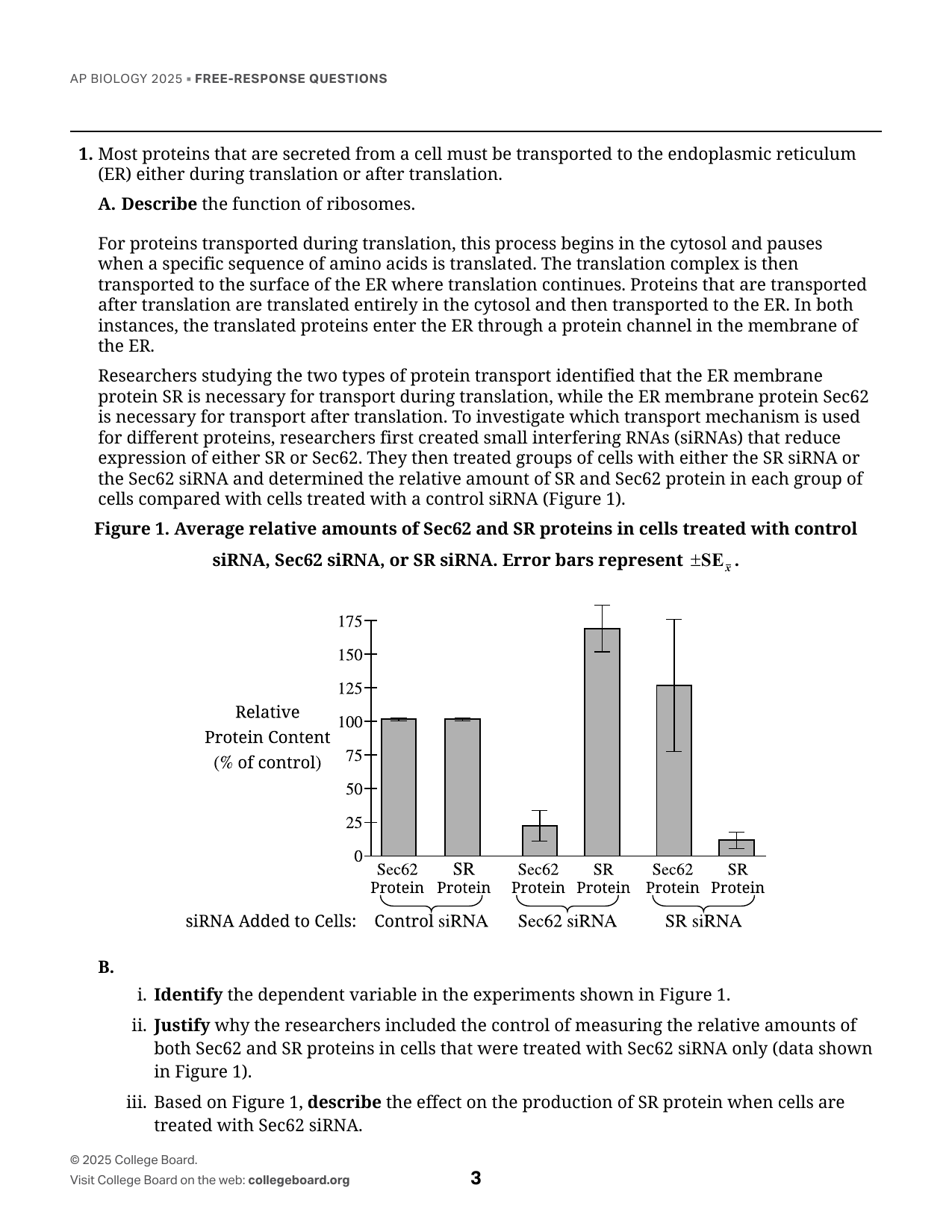
1. Most proteins that are secreted from a cell must be transported to the endoplasmic reticulum (ER) either during translation or after translation. A. Describe the function of ribosomes. For proteins transported during translation, this process begins in the cytosol and pauses when a specific sequence of amino acids is translated. The translation complex is then transported to the surface of the ER where translation continues. Proteins that are transported after translation are translated entirely in the cytosol and then transported to the ER. In both instances, the translated proteins enter the ER through a protein channel in the membrane of the ER. Researchers studying the two types of protein transport identified that the ER membrane protein SR is necessary for transport during translation, while the ER membrane protein Sec62 is necessary for transport after translation. To investigate which transport mechanism is used for different proteins, researchers first created small interfering RNAs (siRNAs) that reduce expression of either SR or Sec62. They then treated groups of cells with either the SR siRNA or the Sec62 siRNA and determined the relative amount of SR and Sec62 protein in each group of cells compared with cells treated with a control siRNA (Figure 1). Figure 1. Average relative amounts of Sec62 and SR proteins in cells treated with control siRNA, Sec62 siRNA, or SR siRNA. Error bars represent ±SEₓ̄. B. i. Identify the dependent variable in the experiments shown in Figure 1. ii. Justify why the researchers included the control of measuring the relative amounts of both Sec62 and SR proteins in cells that were treated with Sec62 siRNA only (data shown in Figure 1). iii. Based on Figure 1, describe the effect on the production of SR protein when cells are treated with Sec62 siRNA. The researchers then measured the amount of each of three different proteins that was transported to the ER in cells treated with Sec62 siRNA or SR siRNA. The researchers calculated the percent transported relative to the cells treated with control siRNA (Figure 2). Figure 2. Average relative amounts of three proteins that were transported to the ER when treated with control siRNA, Sec62 siRNA, or SR siRNA. Error bars represent ±SEₓ̄. C. i. Identify the independent variable in the researchers' second experiment (data shown in Figure 2). ii. Based on Figure 2, identify the protein(s) that when treated with Sec62 siRNA showed an increase in percent transport to the ER compared with the control. iii. Protein 1 is encoded by 234 nucleotides, while protein 2 is encoded by 495 nucleotides. Assuming all nucleotides for both proteins encode amino acids, calculate the difference in the number of amino acids between the two proteins. D. i. Researchers claim that protein 1 is the only tested protein that is transported to the ER following its complete translation in the cytosol. Using data from Figure 2, support the researchers' claim. ii. For any protein that enters the ER, researchers claim that amino acids close to the protein's amino terminus determine how likely the protein is to pass through the protein channel within the ER membrane. Justify the researchers' claim based on your understanding of factors that affect the transport of proteins across membranes.
Rubric Criteria (9)
A1The response states that ribosomes synthesize polypeptides or proteins, perform translation, or are the sites of polypeptide or protein synthesis.
1.0000pts
B1The response identifies the dependent variable in the experiments shown in Figure 1 as the relative amount of protein or protein content.
1.0000pts
B2The response justifies that the control allowed the researchers to determine whether the Sec62 siRNA reduced or affected the content of both proteins relative to the control siRNA, or to determine whether the Sec62 siRNA reduced or affected Sec62 protein content only.
1.0000pts
B3The response states that SR protein production increased when cells are treated with Sec62 siRNA, or states that it increased by 65% (accepting values in the range of 50–80%).
1.0000pts
C1The response identifies the independent variable in the researchers' second experiment (data shown in Figure 2) as the type of siRNA added to the cells, or the type of protein whose amount was measured.
1.0000pts
C2The response identifies Protein 2 and/or Protein 3 as the protein(s) that, when treated with Sec62 siRNA, showed an increase in percent transport to the ER compared with the control.
1.0000pts
C3The response calculates the difference in the number of amino acids between protein 1 and protein 2 as 87 amino acids, using the calculation (495/3) – (234/3).
1.0000pts
D1The response supports the researchers' claim by stating that only protein 1 showed a reduced amount or percentage of transport when cells were treated with Sec62 siRNA.
1.0000pts
D2The response justifies that amino acids at the amino terminus that have similar polarity to or opposite charge to the R groups of amino acids lining the protein channel are more likely to pass through the channel than proteins where the amino terminus contains amino acids with dissimilar polarity or similar charge.
1.0000pts
Dependencies (0)
Page Mapping (2)
Visual Preview
10 boxes
Draw, drag, resize. Advanced coordinates are available if needed.
1
2
3
4
5
6
7
8
9
10
Select a box to edit its role and metadata.
Attribution
This material is the intellectual property of College Board, is not owned by GradeThis, and is shown here for ease of use and demonstration purposes.