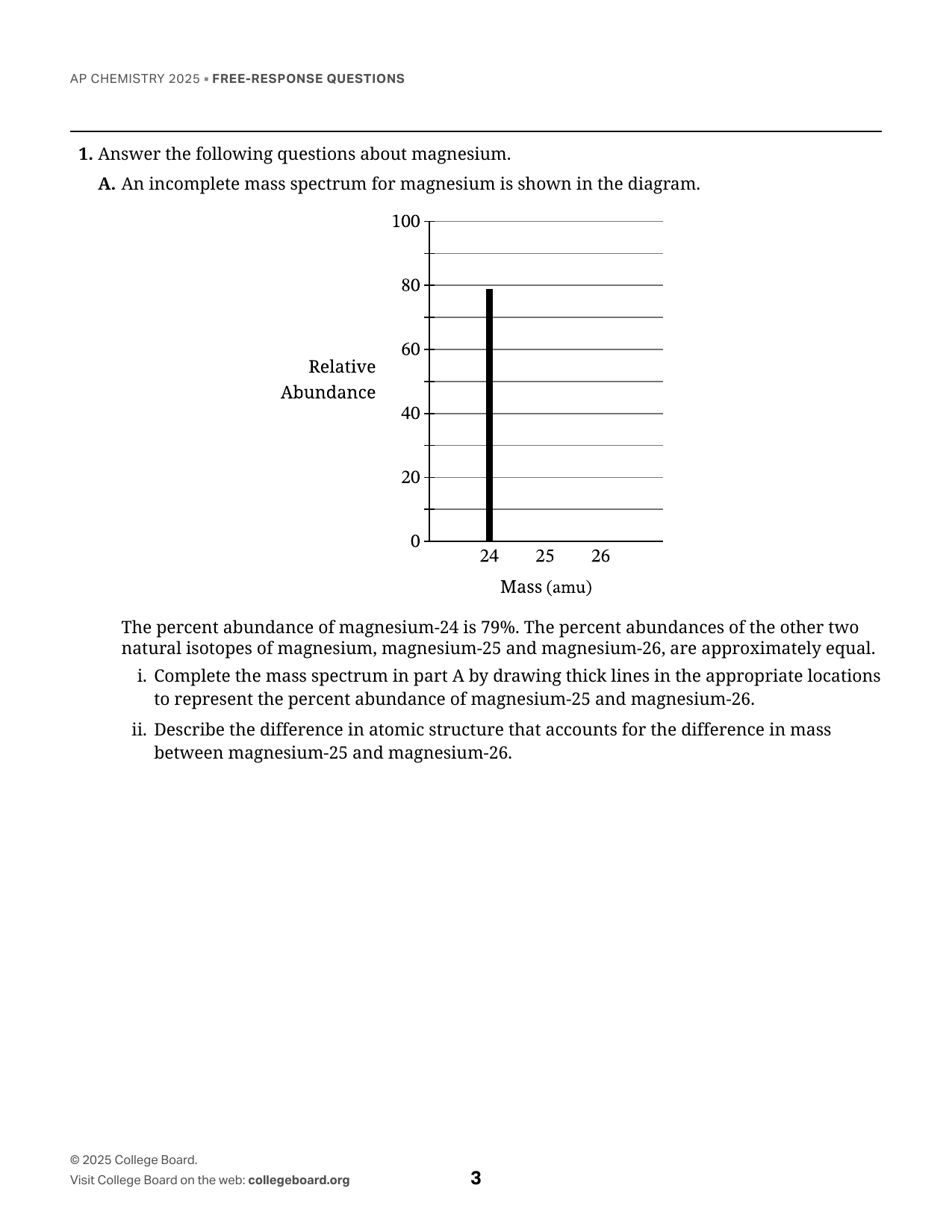
1. Answer the following questions about magnesium. A. An incomplete mass spectrum for magnesium is shown in the diagram. [Diagram: mass spectrum with y-axis labeled Relative Abundance (0–100) and x-axis labeled Mass (amu) (24, 25, 26), showing a peak at mass 24] The percent abundance of magnesium-24 is 79%. The percent abundances of the other two natural isotopes of magnesium, magnesium-25 and magnesium-26, are approximately equal. i. Complete the mass spectrum in part A by drawing thick lines in the appropriate locations to represent the percent abundance of magnesium-25 and magnesium-26. ii. Describe the difference in atomic structure that accounts for the difference in mass between magnesium-25 and magnesium-26. A student prepares a 1.85×10⁻³ M solution of Mg(NO₃)₂(aq) in beaker 1 and a 2.80×10⁻⁴ M solution of NaOH(aq) in beaker 2, as shown. [Diagram: particle diagram of Mg²⁺ surrounded by water molecules, and two beakers labeled Beaker 1: 1.85×10⁻³ M Mg(NO₃)₂(aq), 35.00 mL; Beaker 2: 2.80×10⁻⁴ M NaOH(aq), 50.00 mL] B. The particle diagram shown represents a magnesium ion, Mg²⁺, in beaker 1. A sodium ion, Na⁺, in beaker 2 has a weaker attraction to water than the Mg²⁺ does. Explain this phenomenon using Coulomb’s law and each of the following. i. The relative charge of the ions ii. The relative radii of the ions C. Calculate the pH of the solution in beaker 2. D. A student combines 35.00 mL of 1.85×10⁻³ M Mg(NO₃)₂(aq) with 50.00 mL of 2.80×10⁻⁴ M NaOH(aq), as shown in the diagram. Calculate [Mg²⁺] after the two solutions are combined but before any reaction takes place. (Assume that volumes are additive.) [Diagram: two beakers pouring into a third beaker labeled Beaker 3] E. The dissolution of magnesium hydroxide is represented by the following equation. Mg(OH)₂(s) ⇌ Mg²⁺(aq) + 2 OH⁻(aq) Ksp = 5.61×10⁻¹² i. Write the expression for the solubility product constant, Ksp. ii. After the two solutions are combined in beaker 3 as described in part D, but before any reaction takes place, [OH⁻] = 1.65×10⁻⁴ M. Using your answer to part D, calculate the value of the reaction quotient, Q. iii. Using the reaction quotient, Q, predict whether a precipitate should form as the mixture in beaker 3 approaches equilibrium. Justify your answer. F. In a separate experiment, the student adds HNO₃(aq) to decrease the pH of a saturated solution containing undissolved Mg(OH)₂(s). Does the amount of undissolved Mg(OH)₂(s) increase, decrease, or remain the same as the HNO₃(aq) is added? Justify your answer.
Draw, drag, resize. Advanced coordinates are available if needed.
2. Answer the following questions about ascorbic acid (vitamin C). A. A student combusts a sample of ascorbic acid, CxHyOz, to determine its chemical composition. The only products of the reaction are 0.2400 mol of CO2 and 2.883 g of H2O. i. Calculate the number of moles of H2O produced. ii. The mole ratio of carbon (C) to oxygen (O) is 1:1 in ascorbic acid. Based on this information and your answer to part A(i), determine the empirical formula of ascorbic acid. B. Ascorbic acid, HAsc(aq), acts as a weak acid, as shown in the equation. HAsc(aq) + H2O(l) ⇌ H3O+(aq) + Asc−(aq) The following titration curve was produced when a 10.0 mL sample of HAsc(aq) was titrated using 0.0550 M NaOH(aq). i. Calculate the molar concentration of the ascorbic acid solution. ii. From the titration curve, determine the approximate pKa of ascorbic acid. iii. What is the value of the ratio [Asc−]/[HAsc] when the pH of the solution is 4.7? C. Dehydroascorbic acid (DHAsc) can be produced by reacting ascorbic acid with the triiodide ion, I3−, as represented by the following equation. HAsc + I3− → DHAsc + 3 I− + 2 H+ The student runs three trials of the reaction with different initial concentrations of HAsc and I3−, producing the following data. Trial | [HAsc] (M) | [I3−] (M) | Initial Rate of DHAsc Formation (M/s) 1 | 0.450 | 1.200 | 2.457×10⁻⁴ 2 | 0.450 | 0.600 | 1.229×10⁻⁴ 3 | 0.900 | 1.200 | 4.914×10⁻⁴ i. The rate law for the reaction is rate = k[HAsc][I3−]. Explain how the data in the table support the conclusion that the reaction is first order with respect to [HAsc]. ii. Calculate the value of the rate constant, k, for the reaction. Include units with your answer. D. The triiodide ion, I3−, is significantly more soluble in water than elemental iodine, I2, is. Identify an intermolecular force between I3− and water that is not present between I2 and water, which could explain the difference in solubility. Lewis diagrams for I2 and I3− are provided. $$ :\ddot{I}-\ddot{I}: \quad \left[:\ddot{I}-\ddot{I}:-\ddot{I}:\right]^{-} $$ $$ I_2 \quad I_3^{-} $$
Draw, drag, resize. Advanced coordinates are available if needed.
3. White phosphorus is composed of P4 molecules with a tetrahedral structure, as shown in the diagram on the left. Each P atom is bonded to the other three P atoms by single bonds, as shown in the incomplete Lewis diagram on the right. A. In the box in part A, complete the Lewis diagram for P4 by drawing the nonbonding electrons. B. The reaction of white phosphorus with oxygen to form P4O10(s) is thermodynamically favorable at 298 K. The reaction is represented by equation 1. Equation 1: P4(s) + 5 O2(g) → P4O10(s) i. The entropy change of the reaction, ΔS°, is negative. Using particle-level reasoning, explain why the entropy decreases as the reaction progresses. ii. The enthalpy change of the reaction, ΔH°, is also negative. A student claims that the favorability of the reaction is driven by enthalpy and not by entropy. Is the student's claim correct? Justify your answer by using the relationship between ΔG°, ΔH°, and ΔS°. P4O10(s) reacts exothermically with water to form phosphoric acid, as represented by equation 2. Equation 2: P4O10(s) + 6 H2O(l) → 4 H3PO4(aq) A chemist uses a calorimetry experiment to determine the enthalpy change for the reaction, as represented by the following diagram. C. The chemist carries out the calorimetry experiment and records the following information. Mass of P4O10 | 0.100 g Mass of H2O | 100.0 g Initial temperature | 22.00°C Final temperature | 22.38°C Molar mass of P4O10 | 283.9 g/mol Specific heat of H2O | 4.18 J/(g·°C) i. Calculate the amount of heat, q, released during the experiment, in kJ. Assume that the specific heat of the solution is the same as that of water. ii. Calculate the value of ΔH°rxn for equation 2 in kJ/molrxn. Include the sign in your answer. D. The chemist weighed out 0.100 g P4O10 and 100.0 g of H2O to perform a second trial. In the second trial, some of the solid P4O10 stuck to the weighing paper and was not transferred to the calorimeter. Given that P4O10 is the limiting reactant, would ΔT for the second trial be greater than, less than, or equal to the value in the first trial? Justify your answer. P4(s) also reacts readily with Cl2(g) to produce phosphorus trichloride, PCl3(g), which in turn reacts with Cl2(g) in an equilibrium process to produce PCl5(g). The reactions are represented by equations 3 and 4. Equation 3: P4(s) + 6 Cl2(g) → 4 PCl3(g) ΔH°1 = −1148 kJ/molrxn Equation 4: PCl3(g) + Cl2(g) ⇌ PCl5(g) ΔH°2 = −88 kJ/molrxn E. Calculate the standard enthalpy of formation of PCl5(g) represented by equation 5. Equation 5: 1/4 P4(s) + 5/2 Cl2(g) → PCl5(g) ΔH°f = ? The following particle-level diagram represents the contents of the vessel in an equilibrium mixture at 546 K involving equation 4. F. Equation 4 for the reaction that occurs is shown. Equation 4: PCl3(g) + Cl2(g) ⇌ PCl5(g) ΔH°2 = −88 kJ/molrxn i. If each particle in the diagram represents a partial pressure of 1.00 atm, what is the value of Kp for the equilibrium mixture at 546 K? ii. Does the value of Kp increase, decrease, or remain the same when the temperature is increased to 596 K? Justify your answer based on ΔH°2.
Draw, drag, resize. Advanced coordinates are available if needed.
4. A scientist is investigating the properties of a mixture of CH3OH and H2CO. The scientist generates the following diagram to represent the mixture. A. Identify the hybridization of the valence orbitals of the C atom in the H2CO molecule. B. In the diagram provided, draw a SINGLE dashed line (----) to represent a strong hydrogen-bonding attraction between one CH3OH molecule and one H2CO molecule in the mixture. C. The scientist plans to cool a gaseous mixture of CH3OH and H2CO to form a liquid mixture and finds data on the two compounds. The data are summarized in the table. Substance Melting Point (K) Boiling Point (K) Enthalpy of Vaporization (kJ/mol) CH3OH 176 338 37.6 H2CO 181 254 24.2 i. Propose a temperature to which the mixture should be cooled such that CH3OH and H2CO will both be liquids. ii. The scientist analyzes the mixture after it is cooled and determines that 8.59 g of CH3OH(l) is present. Calculate the amount of thermal energy, in kJ, that was removed to condense the 8.59 g of CH3OH (molar mass 32.04 g/mol) at its boiling point.
Draw, drag, resize. Advanced coordinates are available if needed.
5. Complete Lewis diagrams and some physical properties for compounds X and Y are given. | Compound | X | Y | | :--- | :--- | :--- | | Lewis diagram | Central C bonded to —OH and three —CH3 groups | Central Si bonded to —OH and three —CH3 groups | | Molar mass | 74.1 g/mol | 90.2 g/mol | | Boiling point | 82°C | 98°C | A. Based on VSEPR theory, predict the geometry around the Si atom in compound Y. B. A student claims that compound Y has a higher boiling point than that of compound X because compound Y has stronger London dispersion forces. Do you agree or disagree? Justify your answer. C. An equimolar mixture of the two compounds is heated. When the mixture reaches 82°C, which compound will have the higher vapor pressure? Justify your answer. D. The mixture is heated to 198°C in a sealed, rigid 12.5 L container, at which point both substances are gases and the total pressure in the container is 2.30 atm. Calculate the number of moles of gas particles in the container.
Draw, drag, resize. Advanced coordinates are available if needed.
6. A scientist constructs a galvanic cell as shown in the diagram. As the cell operates, the Zn(s) electrode increases in mass and the Al(s) electrode decreases in mass. A data table with the standard reduction potentials for the substances follows the diagram. Half-Reaction | E° (V) Zn²⁺(aq) + 2e⁻ → Zn(s) | -0.76 Al³⁺(aq) + 3e⁻ → Al(s) | -1.66 A. Write the half-reaction for the oxidation that occurs at the anode. B. Write the balanced net ionic equation for the overall reaction that occurs in the galvanic cell. C. Initially, each electrode has a mass of 50.0 g. The cell is allowed to run for a period of time and is then stopped. Which electrode's mass changed the most? Justify your answer with a calculation. Reduction Half-Reaction | E° (V) Au³⁺(aq) + 3e⁻ → Au(s) | +1.50 Zn²⁺(aq) + 2e⁻ → Zn(s) | -0.76 Mn²⁺(aq) + 2e⁻ → Mn(s) | -1.19 Al³⁺(aq) + 3e⁻ → Al(s) | -1.66 Be²⁺(aq) + 2e⁻ → Be(s) | -1.85 D. The standard Zn/Al cell has a value of E°cell equal to 0.90 V. The scientist needs a galvanic cell that produces a greater voltage. The scientist has access to the chemical systems in the table. If the scientist uses the Zn half-cell and one of the other options from the table, what is the MAXIMUM voltage that could be generated at standard conditions?
Draw, drag, resize. Advanced coordinates are available if needed.
7. Answer the following questions about the glycolate ion, C₂H₃O₃⁻, which acts as a base in aqueous solution. A Lewis diagram for the ion is provided. $$ \left[ \begin{array}{c c c} H & : O: \\ | & || \\ H - \ddot{O} - C - C - \ddot{O}: \\ | \\ H \end{array} \right]^- $$ A. On the Lewis diagram in part A, circle the atom that accepts the proton when the glycolate ion reacts with water. When the glycolate ion reacts with water, it forms glycolic acid, HC₂H₃O₃, according to the following equation. The K_b expression for the reaction is provided. C₂H₃O₃⁻(aq) + H₂O(l) ⇌ HC₂H₃O₃(aq) + OH⁻(aq) K_b = \frac{[HC₂H₃O₃][OH⁻]}{[C₂H₃O₃⁻]} B. At 25°C, a 2.5 M solution of glycolate is found to have [OH⁻] = 1.3 × 10⁻⁵ M. i. Calculate the value of K_b for the glycolate ion. ii. Using your answer to part B(i), calculate the value of K_a for glycolic acid at 25°C. Glycolic acid can be produced from the hydrolysis of methyl glycolate, C₃H₆O₃. A proposed mechanism for the reaction is given. Step 1: C₃H₆O₃ + H₃O⁺ ⇌ C₂H₅O₃⁺ + CH₃OH Step 2: C₂H₅O₃⁺ + H₂O ⇌ HC₂H₃O₃ + H₃O⁺ Overall: C₃H₆O₃ + H₂O ⇌ HC₂H₃O₃ + CH₃OH C. A student claims that H₃O⁺ is a catalyst for the reaction. Do you agree or disagree? Justify your answer based on the mechanism given. STOP END OF EXAM
Draw, drag, resize. Advanced coordinates are available if needed.
This material is the intellectual property of College Board, is not owned by GradeThis, and is shown here for ease of use and demonstration purposes.