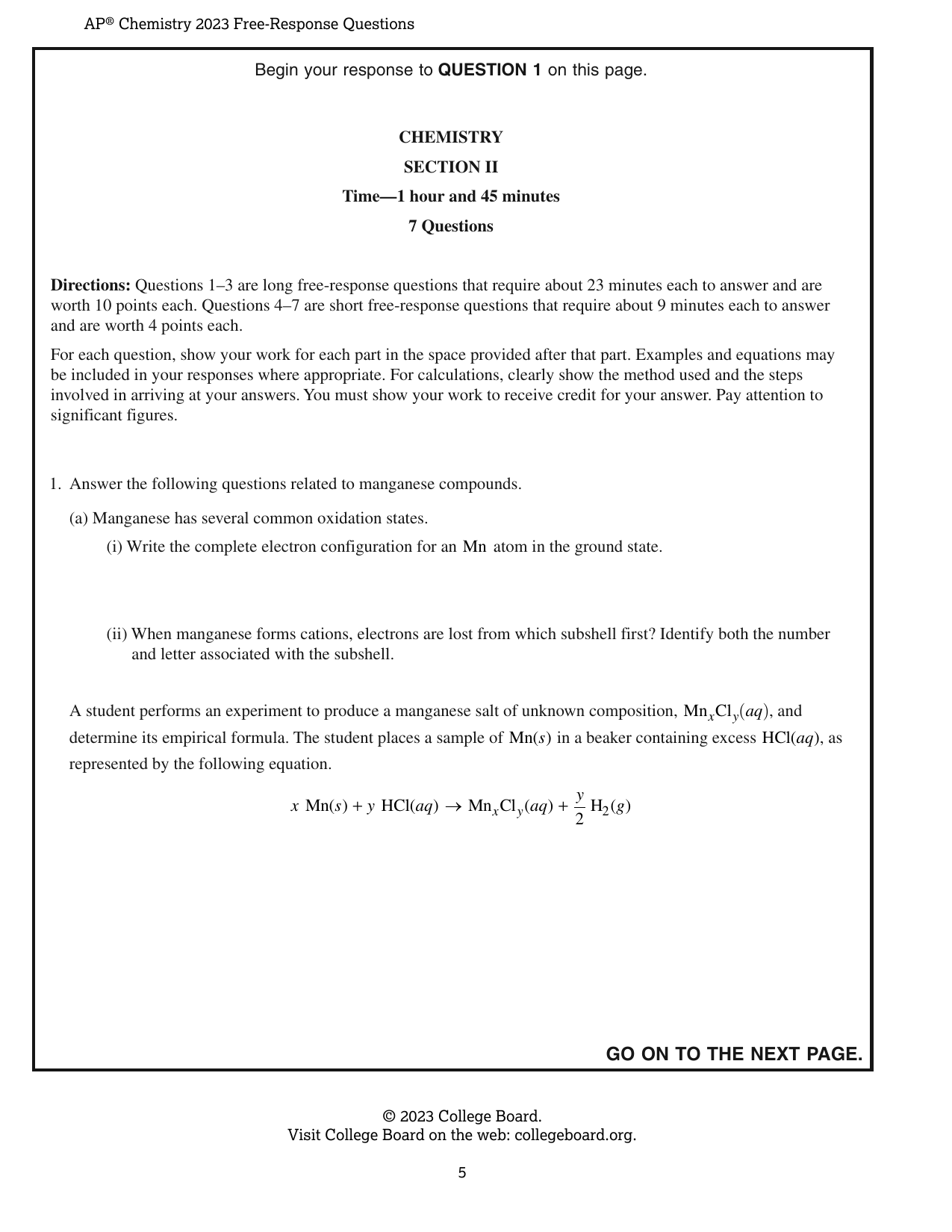
1. Answer the following questions related to manganese compounds. (a) Manganese has several common oxidation states. (i) Write the complete electron configuration for an Mn atom in the ground state. (ii) When manganese forms cations, electrons are lost from which subshell first? Identify both the number and letter associated with the subshell. A student performs an experiment to produce a manganese salt of unknown composition, MnₓClᵧ(aq), and determine its empirical formula. The student places a sample of Mn(s) in a beaker containing excess HCl(aq), as represented by the following equation. x Mn(s) + y HCl(aq) → MnₓClᵧ(aq) + y/2 H₂(g) The student heats the resulting mixture until only MnₓClᵧ(s) remains in the beaker. The data are given in the following table. | Measurement | Mass | |---|---| | Mass of empty beaker | 60.169 g | | Mass of beaker and Mn(s) | 61.262 g | | Mass of beaker and MnₓClᵧ after heating to constant mass | 62.673 g | (b) Calculate the mass of Cl in the sample of MnₓClᵧ(s) remaining in the beaker. (c) Calculate the number of moles of Cl in the sample of MnₓClᵧ(s) remaining in the beaker. (d) The student determines that 0.0199 mol of Mn was used in the experiment. Use the data to determine the empirical formula of the MnₓClᵧ(s). (e) The student repeats the experiment using the same amounts of Mn and HCl and notices that some of the MnₓClᵧ splatters out of the beaker as it is heated to dryness. Will the number of moles of Cl calculated for this trial be greater than, less than, or equal to the number calculated in part (c)? Justify your answer. (f) Another compound of manganese, MnO₂, is used in alkaline batteries, represented by the following diagram. Some half-reactions are given in the table. Diagram labels: Graphite Rod; MnO₂ Paste; KOH Paste; Zinc Case. | Reduction Half-Reaction | E° (V) | |---|---:| | Zn²⁺(aq) + 2 e⁻ → Zn(s) | −0.76 | | ZnO(s) + H₂O(l) + 2 e⁻ → Zn(s) + 2 OH⁻(aq) | −1.28 | | 2 MnO₂(s) + H₂O(l) + 2 e⁻ → Mn₂O₃(s) + 2 OH⁻(aq) | 0.15 | (i) Based on the half-reactions given in the table, write the balanced net ionic equation for the reaction that has the greatest thermodynamic favorability. (ii) Calculate the value of E°cell for the overall reaction. (iii) Calculate the value of ΔG° in kJ/molᵣₓₙ. (iv) A student claims that the total mass of an alkaline battery decreases as the battery operates because the anode loses mass. Do you agree with the student’s claim? Justify your answer.
Draw, drag, resize. Advanced coordinates are available if needed.
2. In the gas phase, AlCl₃ is a molecular substance. A reaction of gaseous AlCl₃ at high temperature is represented by the following balanced equation. Reaction 1: AlCl₃(g) → Al(g) + 3 Cl(g) ΔH₁° = ? (a) How many grams of Cl(g) can be formed from 1.25 mol of AlCl₃(g)? Additional reactions that involve Al or Cl are shown in the following table. Reaction Number | Equation | ΔH°rxn (kJ/molrxn) 2 | Al(s) + 3/2 Cl₂(g) → AlCl₃(g) | −583 3 | Al(s) → Al(g) | +326 4 | Cl₂(g) → 2 Cl(g) | +243 (b) Calculate the value of ΔH₁°, in kJ/molrxn, for reaction 1 above using reactions 2, 3, and 4. (c) A potential energy diagram for Cl₂ is shown in the following graph. [Potential-energy graph shown: vertical axis Energy (kJ/mol), horizontal axis Internuclear Distance (picometers); the curve has a minimum near 200 picometers at approximately −250 kJ/mol.] (i) Based on the graph, what is the bond length, in picometers, for Cl₂? ________ (ii) A student finds that the average Al−Cl bond length is 220 picometers and the average bond energy is 425 kJ/mol. Draw the potential energy curve for the average Al−Cl bond on the preceding graph. (d) Three proposed Lewis diagrams for the AlCl₃(g) molecule are shown. [Three diagrams shown: Diagram 1, Diagram 2, and Diagram 3. Each has a central Al atom bonded to three Cl atoms; Diagram 1 has three single Al−Cl bonds, Diagram 2 has three single Al−Cl bonds with a different lone-electron arrangement on Al, and Diagram 3 has two single Al−Cl bonds and one double Al=Cl bond. Each Cl is shown with lone pairs.] (i) The AlCl₃(g) molecule has a trigonal planar geometry. Which diagram (1, 2, or 3) can be eliminated based on geometry? Justify your choice based on VSEPR theory. (ii) Which of the three diagrams is the best representation for the bonding in AlCl₃? Justify your choice based on formal charges. AlCl₃ is known to dimerize reversibly in the gas phase. The dimerization equilibrium is represented by the following equation. 2 AlCl₃(g) ⇌ Al₂Cl₆(g) (e) Write the expression for the equilibrium constant, Kp, for this reaction. A particle-level diagram of an equilibrium mixture of AlCl₃(g) and Al₂Cl₆(g) at 400°C in a 25 L closed container is shown. [Particle-level diagram shown with legend: open circle = Al; gray circle = Cl. The container depicts AlCl₃ and Al₂Cl₆ particles, including six AlCl₃ monomers and three Al₂Cl₆ dimers.] (f) Using the particle-level diagram, calculate the value of Kp for the reaction if the total pressure in the container is 22.1 atm.
Draw, drag, resize. Advanced coordinates are available if needed.
3. Answer the following questions about an experiment in which CaCO₃(s) is combined with HCl(aq), represented by the following balanced equation. CaCO₃(s) + 2 HCl(aq) → CaCl₂(aq) + CO₂(g) + H₂O(l) (a) Write the balanced net ionic equation for the reaction. A student performs an investigation to study factors that affect the rate of the reaction. In each trial the student combines 50.0 mL of HCl(aq) at 21.2°C with 1.00 g of CaCO₃(s) and measures the time required for the reaction to go to completion. The data are given in the following table. | Trial | Concentration of HCl(aq) (M) | Particle Size of CaCO₃(s) | Time of Reaction (s) | |---|---:|---|---:| | 1 | 1.00 | Fine powder | 67 | | 2 | 1.00 | Small chunks | 112 | | 3 | 1.00 | Large chunk | 342 | | 4 | 3.00 | Fine powder | 22 | | 5 | 3.00 | Small chunks | 227 | | 6 | 3.00 | Large chunk | 114 | (b) The student correctly identifies that trial 5 is inconsistent with the other trials. Explain why the student’s claim is correct using the data in the table. (c) Based on the reaction conditions and the collisions that occur between particles, explain the reason for the difference in the reaction times for trial 2 and trial 3. (d) The student claims that the reaction is zero order with respect to HCl(aq). Do you agree or disagree with the student’s claim? Justify your answer using the student’s data. (e) The HCl(aq) was present in excess in all trials of the experiment. Determine the molarity of the HCl(aq) in the beaker after the reaction is complete in trial 2. Assume that the volume of the mixture remains constant at 50.0 mL throughout the trial. (The molar mass of CaCO₃ is 100.09 g/mol.) CaCO₃(s) + 2 HCl(aq) → CaCl₂(aq) + CO₂(g) + H₂O(l) In order to measure the enthalpy of the reaction shown, the student repeats trial 1 by mixing 50.0 mL of HCl(aq) with 1.00 g of CaCO₃(s) using a coffee cup calorimeter. The student records the temperature of the system every 20 seconds. The data are given in the following table. | Time (s) | Measured Temperature of Solution (°C) | |---:|---:| | 0 | 21.20 | | 20 | 21.51 | | 40 | 21.70 | | 60 | 21.85 | | 80 | 21.90 | | 100 | 21.90 | (f) Is the reaction endothermic or exothermic? Justify your answer using the information in the table. (g) Based on the experimental data, the mass of the system is 51.0 g, and the specific heat of the reaction mixture is 4.0 J/(g · °C). (i) Calculate the magnitude of heat transfer, q, in joules. (ii) Calculate the enthalpy of reaction in units of kJ/mol_rxn. Include the algebraic sign on your answer.
Draw, drag, resize. Advanced coordinates are available if needed.
4. A student is asked to prepare a buffer solution made with equimolar amounts of CH₃NH₂(aq) and CH₃NH₃Cl(s). The student uses 25.00 mL of 0.100 M CH₃NH₂(aq), which contains 0.00250 mol of CH₃NH₂, to make the buffer. (a) Calculate the mass of CH₃NH₃Cl(s) that contains 0.00250 mol of CH₃NH₃Cl. The student has the following materials and equipment available. • Distilled water • Electronic balance • 50 mL beaker • Pipets • 0.100 M CH₃NH₂(aq) • Weighing paper • 10.0 mL graduated cylinder • pH meter • Solid CH₃NH₃Cl • 50.00 mL buret • Small spatula (b) The following table contains a partial procedure for making the buffer solution. Fill in steps 1 and 4 to complete the procedure using only materials and equipment selected from the choices given. (Not all materials listed will be used. Assume that all appropriate safety measures are already in place.) Step | Procedure 1 | 2 | Place the solid in the 50 mL beaker. 3 | Clean the buret and rinse with distilled water. 4 | 5 | Use the buret to add 25.00 mL of 0.100 M CH₃NH₂(aq) to the beaker. 6 | Mix well. 7 | Check the pH with the pH meter. The value of Kb for CH₃NH₂(aq) is 4.4 × 10⁻⁴, and the pH of the buffer the student prepared is 10.64. (c) The student prepares a second buffer solution. The student uses 25.00 mL of 0.050 M CH₃NH₂(aq) instead of 25.00 mL of 0.100 M CH₃NH₂(aq), and half the mass of CH₃NH₃Cl(s) that was used in the first buffer. Is the pH of the second buffer greater than, less than, or equal to the pH of the first buffer? Justify your answer.
Draw, drag, resize. Advanced coordinates are available if needed.
5. HCl is a molecular gas as a pure substance but acts as an acid in aqueous solution. (a) A sample of HCl(g) is stored in a rigid 6.00 L container at 7.45 atm and 296 K. (i) Calculate the number of moles of HCl(g) in the container. (ii) The rigid 6.00 L container of HCl(g) is cooled to a temperature of 271 K. Calculate the new pressure, in atm, of the HCl(g). (b) When HCl ionizes in aqueous solution, Cl−(aq) ions are formed. In the following box, draw three water molecules with proper orientation around the Cl− ion. Use the water-molecule symbol shown to represent water molecules. (c) The following particulate diagram represents the ionization of one of the acids in the data table. Water molecules have been omitted for clarity. Which acid (HNO2, HCl, or HClO4) is represented in the diagram? Justify your answer using the information in the table. The Ka values for three acids are shown in the preceding table. Acid (HA) | Anion (A−) | Ka Value HNO2 | NO2− | 5.6 × 10⁻⁴ HCl | Cl− | 2.0 × 10^7 HClO4 | ClO4− | 1.6 × 10^15 Particulate diagram legend: H3O+; HA; A−.
Draw, drag, resize. Advanced coordinates are available if needed.
6. Answer the following questions related to HBr(l) and HF(l). (a) In the following table, list all of the types of intermolecular forces present in pure samples of HBr(l) and HF(l). Liquid | HBr(l) | HF(l) Intermolecular forces present | | (b) The enthalpy of vaporization, ΔH°vap, for each liquid is provided in the following table. Liquid | HBr(l) | HF(l) ΔH°vap | 17.3 kJ/mol | 25.2 kJ/mol (i) Based on the types and relative strengths of intermolecular forces, explain why ΔH°vap of HF(l) is greater than that of HBr(l). (ii) Calculate the amount of thermal energy, in kJ, required to vaporize 6.85 g of HF(l). (c) Based on the arrangement of electrons in the Br and F atoms, explain why the bond length in an HBr molecule is greater than that in an HF molecule.
Draw, drag, resize. Advanced coordinates are available if needed.
Begin your response to QUESTION 7 on this page. 7. Strontium hydroxide dissolves in water according to the following equation. The Ksp expression for strontium hydroxide is provided. Sr(OH)2(s) ⇌ Sr2+(aq) + 2 OH−(aq) Ksp = [Sr2+][OH−]2 A particulate diagram is shown. The legend indicates that a gray circle represents Sr2+ and a white circle paired with a small black circle represents OH−. (Water molecules are intentionally omitted.) (a) A student draws the particulate diagram shown to represent the ions present in an aqueous solution of Sr(OH)2. (Water molecules are intentionally omitted.) Identify the error in the student’s drawing. (b) The student prepares a saturated solution by adding excess Sr(OH)2(s) to distilled water and stirring until no more solid dissolves. The student then determines that [Sr2+] = 0.043 M in the solution. (i) Calculate the value of [OH−] in the solution. (ii) Calculate the value of Ksp for Sr(OH)2. (c) The student prepares a second saturated solution of Sr(OH)2 in aqueous 0.10 M Sr(NO3)2 instead of water. Will the value of [OH−] in the second solution be greater than, less than, or equal to the value in the first solution? Justify your answer. (Assume constant temperature.)
Draw, drag, resize. Advanced coordinates are available if needed.
This material is the intellectual property of College Board, is not owned by GradeThis, and is shown here for ease of use and demonstration purposes.