2023 AP Microeconomics Free-Response Questions
Advanced PlacementAP MicroeconomicsEconomicsFree Response
3 questions20 pts
3 gradable20 rubric criteria0 dependencies
q1Question 1
q1
Question 1
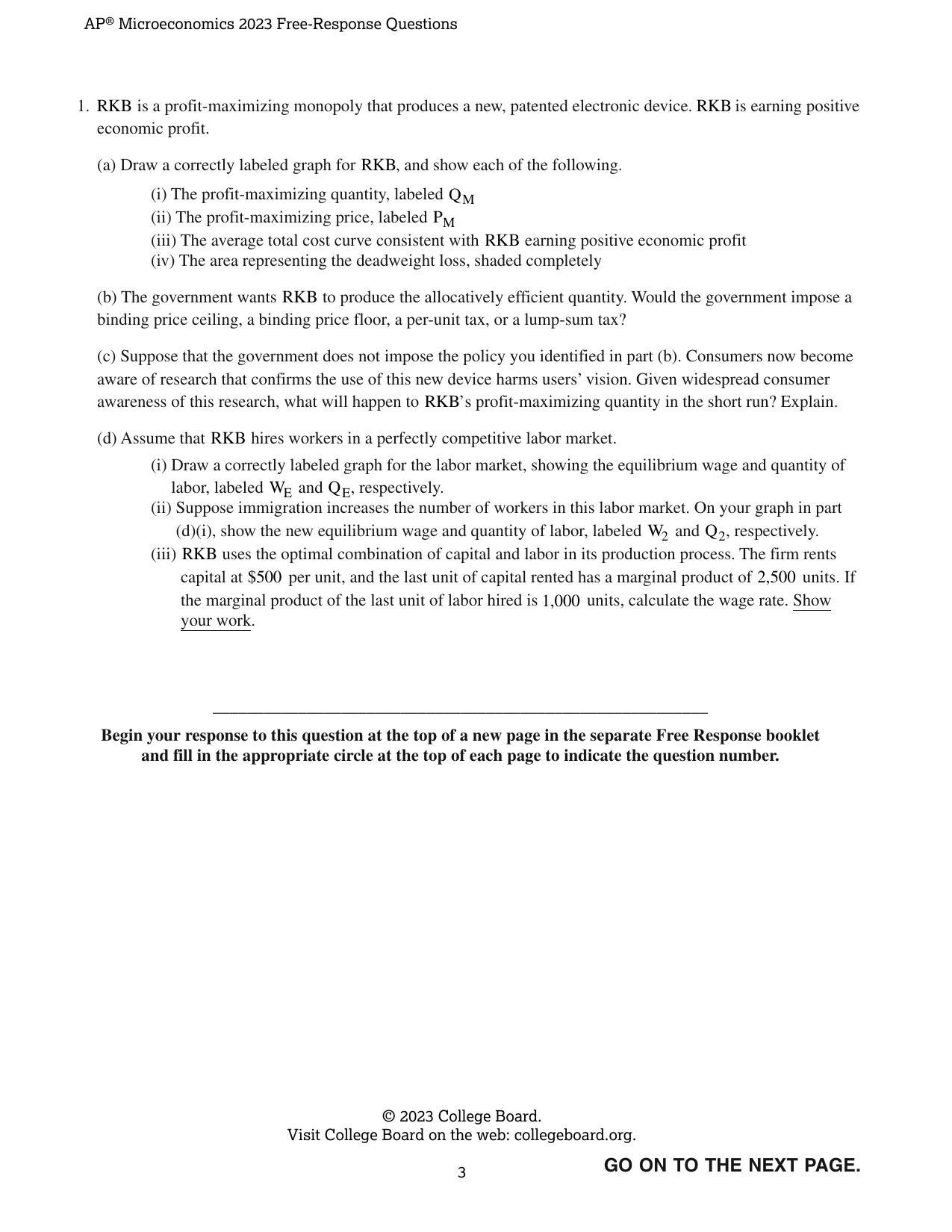
1. RKB is a profit-maximizing monopoly that produces a new, patented electronic device. RKB is earning positive economic profit. (a) Draw a correctly labeled graph for RKB, and show each of the following. (i) The profit-maximizing quantity, labeled Q_M (ii) The profit-maximizing price, labeled P_M (iii) The average total cost curve consistent with RKB earning positive economic profit (iv) The area representing the deadweight loss, shaded completely (b) The government wants RKB to produce the allocatively efficient quantity. Would the government impose a binding price ceiling, a binding price floor, a per-unit tax, or a lump-sum tax? (c) Suppose that the government does not impose the policy you identified in part (b). Consumers now become aware of research that confirms the use of this new device harms users' vision. Given widespread consumer awareness of this research, what will happen to RKB's profit-maximizing quantity in the short run? Explain. (d) Assume that RKB hires workers in a perfectly competitive labor market. (i) Draw a correctly labeled graph for the labor market, showing the equilibrium wage and quantity of labor, labeled W_E and Q_E, respectively. (ii) Suppose immigration increases the number of workers in this labor market. On your graph in part (d)(i), show the new equilibrium wage and quantity of labor, labeled W_2 and Q_2, respectively. (iii) RKB uses the optimal combination of capital and labor in its production process. The firm rents capital at $500 per unit, and the last unit of capital rented has a marginal product of 2,500 units. If the marginal product of the last unit of labor hired is 1,000 units, calculate the wage rate. Show your work. Begin your response to this question at the top of a new page in the separate Free Response booklet and fill in the appropriate circle at the top of each page to indicate the question number.
Rubric Criteria (10)
C1The response draws a correctly labeled graph of a monopoly with a downward-sloping demand (D) curve and a downward-sloping marginal revenue (MR) curve with the MR curve below the D curve.
1.0000pts
C2The graph shows a marginal cost (MC) curve and the profit-maximizing quantity, labeled QM, where MR = MC.
1.0000pts
C3The graph shows the profit-maximizing price, labeled PM, from the demand curve at QM.
1.0000pts
C4The graph shows the average total cost (ATC) curve below PM at QM and the MC curve passing through the minimum point of the ATC curve.
1.0000pts
C5The graph shows the area of the deadweight loss, shaded completely.
1.0000pts
C6The response states that the government would impose a binding price ceiling.
1.0000pts
C7The response states that the profit-maximizing quantity will decrease and explains that the demand for the device will decrease, causing the MR curve to shift to the left, intersecting the MC curve at a lower quantity.
1.0000pts
C8The response draws a correctly labeled graph of a perfectly competitive labor market with a downward-sloping demand (D) curve and an upward-sloping supply (S) curve and shows the equilibrium wage and quantity of labor, labeled WE and QE, respectively.
1.0000pts
C9The graph from part (d)(i) shows a rightward shift in the labor supply curve, resulting in a lower equilibrium wage rate, labeled W2, and a higher equilibrium quantity of labor, labeled Q2.
1.0000pts
C10The response calculates the wage rate as $200 and shows work using the equation that equates the ratio of marginal product of capital to rental price with the ratio of marginal product of labor to wage rate.
1.0000pts
Dependencies (0)
Page Mapping (1)
Visual Preview
3 boxes
Draw, drag, resize. Advanced coordinates are available if needed.
1
2
3
Select a box to edit its role and metadata.
Attribution
This material is the intellectual property of College Board, is not owned by GradeThis, and is shown here for ease of use and demonstration purposes.