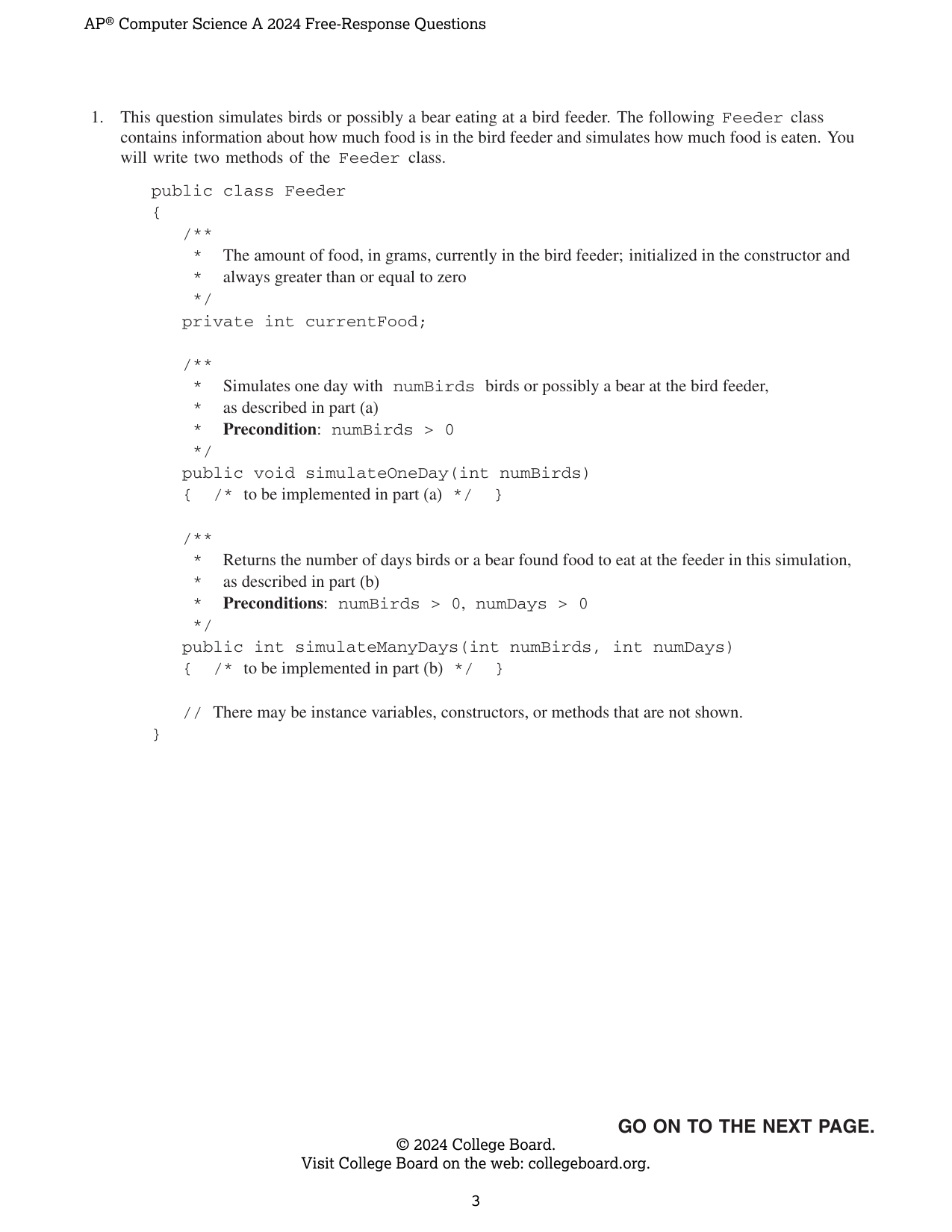
1. This question simulates birds or possibly a bear eating at a bird feeder. The following Feeder class contains information about how much food is in the bird feeder and simulates how much food is eaten. You will write two methods of the Feeder class. public class Feeder { /** * The amount of food, in grams, currently in the bird feeder; initialized in the constructor and * always greater than or equal to zero */ private int currentFood; /** * Simulates one day with numBirds birds or possibly a bear at the bird feeder, * as described in part (a) * Precondition: numBirds > 0 */ public void simulateOneDay(int numBirds) { /* to be implemented in part (a) */ } /** * Returns the number of days birds or a bear found food to eat at the feeder in this simulation, * as described in part (b) * Preconditions: numBirds > 0, numDays > 0 */ public int simulateManyDays(int numBirds, int numDays) { /* to be implemented in part (b) */ } // There may be instance variables, constructors, or methods that are not shown. } (a) Write the simulateOneDay method, which simulates numBirds birds or possibly a bear at the feeder for one day. The method determines the amount of food taken from the feeder on this day and updates the currentFood instance variable. The simulation accounts for normal conditions, which occur 95% of the time, and abnormal conditions, which occur 5% of the time. Under normal conditions, the simulation assumes that on any given day, only birds visit the feeder and that each bird at the feeder consumes the same amount of food. This standard amount consumed is between 10 and 50 grams of food, inclusive, in 1-gram increments. That is, on any given day, each bird might eat 10, 11, ..., 49, or 50 grams of food. The amount of food eaten by each bird on a given day is randomly generated and each integer from 10 to 50, inclusive, has an equal chance of being chosen. For example, a run of the simulation might predict that for a certain day under normal conditions, each bird coming to the feeder will eat 11 grams of food. If 10 birds come to the feeder on that day, then a total of 110 grams of food will be consumed. If the simulated food consumed is greater than the amount of food in the feeder, the birds empty the feeder and the amount of food in the feeder at the end of the day is zero. Under abnormal conditions, a bear empties the feeder and the amount of food in the feeder at the end of the day is zero. The following examples show possible results of three calls to simulateOneDay. - Example 1: If the feeder initially contains 500 grams of food, the call simulateOneDay(12) could result in 12 birds eating 20 grams of food each, leaving 260 grams of food in the feeder. - Example 2: If the feeder initially contains 1,000 grams of food, the call simulateOneDay(22) could result in a bear eating all the food, leaving 0 grams of food in the feeder. - Example 3: If the feeder initially contains 100 grams of food, the call simulateOneDay(5) could result in 5 birds attempting to eat 30 grams of food each. Since the feeder initially contains less than 150 grams of food, the feeder is emptied, leaving 0 grams of food in the feeder. Complete the simulateOneDay method. /** * Simulates one day with numBirds birds or possibly a bear at the bird feeder, * as described in part (a) * Precondition: numBirds > 0 */ public void simulateOneDay(int numBirds) Begin your response at the top of a new page in the separate Free Response booklet and fill in the appropriate circle at the top of each page to indicate the question number. If there are multiple parts to this question, write the part letter with your response. Class information for this question public class Feeder private int currentFood public void simulateOneDay(int numBirds) public int simulateManyDays(int numBirds, int numDays) (b) Write the simulateManyDays method. The method uses simulateOneDay to simulate numBirds birds or a bear coming to the feeder on at most numDays consecutive days. The simulation returns the number of days that birds or a bear found food at the feeder. Consider the following examples. Value of currentFood and Method Call | Possible Outcomes and Resulting Return Value ---|--- currentFood: 2400 simulateManyDays(10, 4) | Day 1: simulateOneDay leaves 2100 grams of food in the feeder. Day 2: simulateOneDay leaves 1650 grams of food in the feeder. Day 3: simulateOneDay leaves 1500 grams of food in the feeder. Day 4: simulateOneDay leaves 1260 grams of food in the feeder. The simulation returns 4 because, on all four days of the simulation, birds or a bear found food at the feeder. The instance variable currentFood has the value 1260. currentFood: 250 simulateManyDays(10, 5) | Day 1: simulateOneDay leaves 150 grams of food in the feeder. Day 2: simulateOneDay leaves 0 grams of food in the feeder. The simulation returns 2 because, on two of the five simulated days, birds or a bear found food at the feeder. The instance variable currentFood has the value 0. currentFood: 0 simulateManyDays(5, 10) | The simulation returns 0 because no food was found at the feeder on any day. The instance variable currentFood has the value 0. Complete the simulateManyDays method. Assume that simulateOneDay works as intended, regardless of what you wrote in part (a). You must use simulateOneDay appropriately in order to receive full credit. /** * Returns the number of days birds or a bear found food to eat at the feeder in this simulation, * as described in part (b) * Preconditions: numBirds > 0, numDays > 0 */ public int simulateManyDays(int numBirds, int numDays) Begin your response at the top of a new page in the separate Free Response booklet and fill in the appropriate circle at the top of each page to indicate the question number. If there are multiple parts to this question, write the part letter with your response. Class information for this question public class Feeder private int currentFood public void simulateOneDay(int numBirds) public int simulateManyDays(int numBirds, int numDays)
Draw, drag, resize. Advanced coordinates are available if needed.
2. This question involves a scoreboard for a game. The game is played between two teams who alternate turns so that at any given time, one team is active and the other team is inactive. During a turn, a team makes one or more plays. Each play can score one or more points and the team’s turn continues, or the play can fail, in which case no points are scored and the team’s turn ends. The Scoreboard class, which you will write, is used to keep track of the score in a game. The Scoreboard class contains a constructor and two methods. - The constructor has two parameters. The first parameter is a String containing the name of team 1, and the second parameter is a String containing the name of team 2. The game always begins with team 1 as the active team. - The recordPlay method has a single nonnegative integer parameter that is equal to the number of points scored on a play or 0 if the play failed. If the play results in one or more points scored, the active team’s score is updated and that team remains active. If the value of the parameter is 0, the active team’s turn ends and the inactive team becomes the active team. The recordPlay method does not return a value. - The getScore method has no parameters. The method returns a String containing information about the current state of the game. The returned string begins with the score of team 1, followed by a hyphen ("-"), followed by the score of team 2, followed by a hyphen, followed by the name of the team that is currently active. The following table contains a sample code execution sequence and the corresponding results. The code execution sequence appears in a class other than Scoreboard. Statement | Value Returned (blank if none) | Explanation String info; | | Scoreboard game = new Scoreboard("Red", "Blue"); | | game is a new Scoreboard for a game played between team 1, whose name is "Red", and team 2, whose name is "Blue". The active team is set to team 1. info = game.getScore(); | "0-0-Red" | game.recordPlay(1); | | Team 1 earns 1 point because the game always begins with team 1 as the active team. info = game.getScore(); | "1-0-Red" | game.recordPlay(0); | | Team 1’s play failed, so team 2 is now active. info = game.getScore(); | "1-0-Blue" | info = game.getScore(); | "1-0-Blue" | The score and state of the game are unchanged since the last call to getScore. game.recordPlay(3); | | Team 2 earns 3 points. info = game.getScore(); | "1-3-Blue" | game.recordPlay(1); | | Team 2 earns 1 point. game.recordPlay(0); | | Team 2’s play failed, so team 1 is now active. info = game.getScore(); | "1-4-Red" | game.recordPlay(0); | | Team 1’s play failed, so team 2 is now active. game.recordPlay(4); | | Team 2 earns 4 points. game.recordPlay(0); | | Team 2’s play failed, so team 1 is now active. info = game.getScore(); | "1-8-Red" | Scoreboard match = new Scoreboard("Lions", "Tigers"); | | match is a new and independent Scoreboard object. info = match.getScore(); | "0-0-Lions" | info = game.getScore(); | "1-8-Red" | Write the complete Scoreboard class. Your implementation must meet all specifications and conform to the examples shown in the preceding table. Begin your response at the top of a new page in the separate Free Response booklet and fill in the appropriate circle at the top of each page to indicate the question number. If there are multiple parts to this question, write the part letter with your response.
Draw, drag, resize. Advanced coordinates are available if needed.
3. This question involves the manipulation and analysis of a list of words. The following WordChecker class contains an ArrayList<String> to be analyzed and methods that are used to perform the analysis. You will write two methods of the WordChecker class. public class WordChecker { /** Initialized in the constructor and contains no null elements */ private ArrayList<String> wordList; /** * Returns true if each element of wordList (except the first) contains the previous * element as a substring and returns false otherwise, as described in part (a) * Precondition: wordList contains at least two elements. * Postcondition: wordList is unchanged. */ public boolean isWordChain() { /* to be implemented in part (a) */ } /** * Returns an ArrayList<String> based on strings from wordList that start * with target, as described in part (b). Each element of the returned ArrayList has had * the initial occurrence of target removed. * Postconditions: wordList is unchanged. * Items appear in the returned list in the same order as they appear in wordList. */ public ArrayList<String> createList(String target) { /* to be implemented in part (b) */ } // There may be instance variables, constructors, and methods that are not shown. } (a) Write the isWordChain method, which determines whether each element of wordList (except the first) contains the previous element as a substring. The following table shows two sample isWordChain method calls. wordList | isWordChain Return Value | Explanation ["an", "band", "band", "abandon"] | true | Each element contains the previous element as a substring. ["to", "too", "stool", "tools"] | false | "tools" does not contain the substring "stool". Complete the isWordChain method. /** * Returns true if each element of wordList (except the first) contains the previous * element as a substring and returns false otherwise, as described in part (a) * Precondition: wordList contains at least two elements. * Postcondition: wordList is unchanged. */ public boolean isWordChain() Begin your response at the top of a new page in the separate Free Response booklet and fill in the appropriate circle at the top of each page to indicate the question number. If there are multiple parts to this question, write the part letter with your response. (b) Write the createList method, which creates and returns an ArrayList<String>. The method identifies strings in wordList that start with target and returns a new ArrayList containing each identified string without the starting occurrence of target. Elements must appear in the returned list in the same order as they appear in wordList. Consider an example where wordList contains the following strings. ["catch", "bobcat", "catchacat", "cat", "at"] The following table shows the ArrayList returned by some calls to createList. In all cases, wordList is unchanged. Method Call | ArrayList Returned by createList | Explanation createList("cat") | ["ch", "chacat", ""] | Only "catch", "catchacat", and "cat" begin with "cat". createList("catch") | ["", "acat"] | Only "catch" and "catchacat" begin with "catch". createList("dog") | [] | None of the words in wordList begin with "dog". Complete the createList method. /** * Returns an ArrayList<String> based on strings from wordList that start * with target, as described in part (b). Each element of the returned ArrayList has had * the initial occurrence of target removed. * Postconditions: wordList is unchanged. * Items appear in the returned list in the same order as they appear in wordList. */ public ArrayList<String> createList(String target) Begin your response at the top of a new page in the separate Free Response booklet and fill in the appropriate circle at the top of each page to indicate the question number. If there are multiple parts to this question, write the part letter with your response. Class information for this question public class WordChecker private ArrayList<String> wordList public boolean isWordChain() public ArrayList<String> createList(String target)
Draw, drag, resize. Advanced coordinates are available if needed.
4. This question involves a path through a two-dimensional (2D) array of integers, where the path is based on the values of elements in the array. When an element of the 2D array is accessed, the first index is used to specify the row and the second index is used to specify the column. The following Location class represents a row and column position in the 2D array. public class Location { private int theRow; private int theCol; public Location(int r, int c) { theRow = r; theCol = c; } public int getRow() { return theRow; } public int getCol() { return theCol; } } The following GridPath class contains the 2D array and methods to use to determine a path through the array. You will write two methods of the GridPath class. public class GridPath { /** Initialized in the constructor with distinct values that never change */ private int[][] grid; /** * Returns the Location representing a neighbor of the grid element at row and col, * as described in part (a) * Preconditions: row is a valid row index and col is a valid column index in grid. * row and col do not specify the element in the last row and last column of grid. */ public Location getNextLoc(int row, int col) { /* to be implemented in part (a) */ } /** * Computes and returns the sum of all values on a path through grid, as described in * part (b) * Preconditions: row is a valid row index and col is a valid column index in grid. * row and col do not specify the element in the last row and last column of grid. */ public int sumPath(int row, int col) { /* to be implemented in part (b) */ } // There may be instance variables, constructors, and methods that are not shown. } (a) Write the getNextLoc method, which returns a Location object that represents the smaller of two neighbors of the grid element at row and col, according to the following rules. - The two neighbors that are considered are the element below the given element and the element to the right of the given element, if they exist. - If both neighbors exist, the Location of the neighbor with the smaller value is returned. Two neighbors will always have different values. - If only one neighbor exists, the Location of the existing neighbor is returned. For example, assume that grid contains the following values. 0 1 2 3 4 0 12 3 4 13 5 1 11 21 2 14 16 2 7 8 9 15 0 3 10 17 20 19 1 4 18 22 30 25 6 The following table shows some sample calls to getNextLoc. Method Call Explanation getNextLoc(0, 0) Returns the neighbor to the right (the Location representing the element at row 0 and column 1), since 3 < 11 getNextLoc(1, 3) Returns the neighbor below (the Location representing the element at row 2 and column 3), since 15 < 16 getNextLoc(2, 4) Returns the neighbor below (the Location representing the element at row 3 and column 4), since the given element has no neighbor to the right getNextLoc(4, 3) Returns the neighbor to the right (the Location representing the element at row 4 and column 4), since the given element has no neighbor below In the example, the getNextLoc method will never be called with row 4 and column 4, as those values would violate the precondition of the method. Complete the getNextLoc method. /** * Returns the Location representing a neighbor of the grid element at row and col, * as described in part (a) * * Preconditions: row is a valid row index and col is a valid column index in grid. * row and col do not specify the element in the last row and last column of grid. */ public Location getNextLoc(int row, int col) Begin your response at the top of a new page in the separate Free Response booklet and fill in the appropriate circle at the top of each page to indicate the question number. If there are multiple parts to this question, write the part letter with your response. Class information for this question public class Location private int theRow private int theCol public Location(int r, int c) public int getRow() public int getCol() public class GridPath private int[][] grid public Location getNextLoc(int row, int col) public int sumPath(int row, int col) (b) Write the sumPath method, which returns the sum of all values on a path in grid. The path begins with the element at row and col and is determined by successive calls to getNextLoc. The path ends when the element in the last row and the last column of grid is reached. For example, consider the following contents of grid. The shaded elements of grid represent the values on the path that results from the method call sumPath(1, 1). The method call returns 19 because 3 + 2 + 9 + 4 + 0 + 1 = 19. 0 1 2 3 4 0 12 30 40 25 5 1 11 3 22 15 43 2 7 2 9 4 0 3 8 33 18 6 1 Write the sumPath method. Assume getNextLoc works as intended, regardless of what you wrote in part (a). You must use getNextLoc appropriately in order to receive full credit. /** * Computes and returns the sum of all values on a path through grid, as described in * part (b) * * Preconditions: row is a valid row index and col is a valid column index in grid. * row and col do not specify the element in the last row and last column of grid. */ public int sumPath(int row, int col) Begin your response at the top of a new page in the separate Free Response booklet and fill in the appropriate circle at the top of each page to indicate the question number. If there are multiple parts to this question, write the part letter with your response. Class information for this question public class Location private int theRow private int theCol public Location(int r, int c) public int getRow() public int getCol() public class GridPath private int[][] grid public Location getNextLoc(int row, int col) public int sumPath(int row, int col)
Draw, drag, resize. Advanced coordinates are available if needed.
This material is the intellectual property of College Board, is not owned by GradeThis, and is shown here for ease of use and demonstration purposes.