2025 AP Computer Science A Free-Response Questions
Advanced PlacementAP Computer Science AComputer ScienceFree Response
4 questions36 pts
4 gradable36 rubric criteria0 dependencies
q1Question 1
q1
Question 1
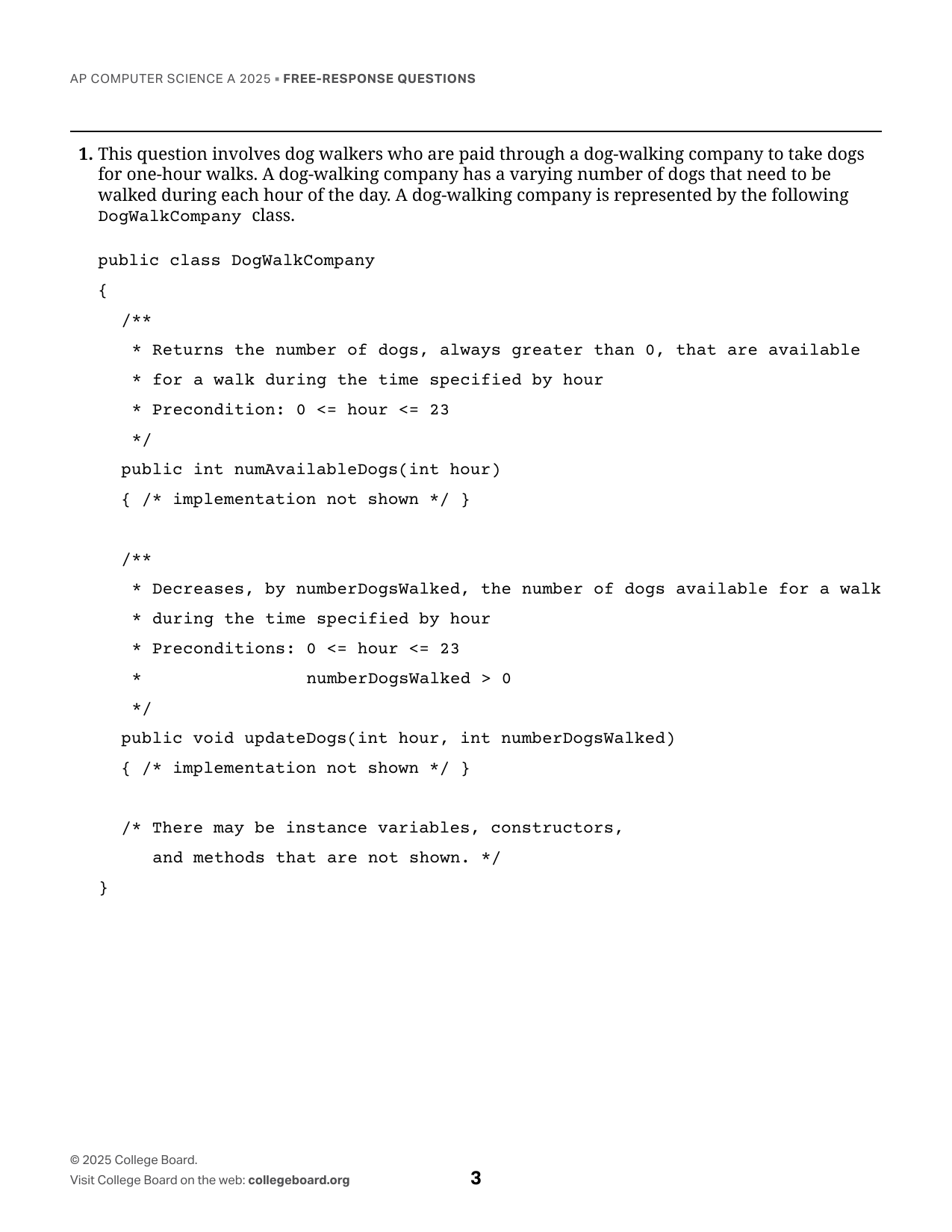
1. This question involves dog walkers who are paid through a dog-walking company to take dogs for one-hour walks. A dog-walking company has a varying number of dogs that need to be walked during each hour of the day. A dog-walking company is represented by the following DogWalkCompany class. public class DogWalkCompany { /** * Returns the number of dogs, always greater than 0, that are available * for a walk during the time specified by hour * Precondition: 0 <= hour <= 23 */ public int numAvailableDogs(int hour) { /* implementation not shown */ } /** * Decreases, by numberDogsWalked, the number of dogs available for a walk * during the time specified by hour * Preconditions: 0 <= hour <= 23 * numberDogsWalked > 0 */ public void updateDogs(int hour, int numberDogsWalked) { /* implementation not shown */ } /* There may be instance variables, constructors, and methods that are not shown. */ } A dog walker is associated with a dog-walking company and is represented by the DogWalker class. You will write two methods of the DogWalker class. public class DogWalker { /** The maximum number of dogs this walker can walk simultaneously per hour */ private int maxDogs; /** The dog-walking company this dog walker is associated with */ private DogWalkCompany company; /** * Assigns max to maxDogs and comp to company * Precondition: max > 0 */ public DogWalker(int max, DogWalkCompany comp) { /* implementation not shown */ } /** * Takes at least one dog for a walk during the time specified by * hour, as described in part (a) * Preconditions: 0 <= hour <= 23 * maxDogs > 0 */ public int walkDogs(int hour) { /* to be implemented in part (a) */ } /** * Performs an entire dog-walking shift and returns the amount * earned, in dollars, as described in part (b) * Preconditions: 0 <= startHour <= endHour <= 23 * maxDogs > 0 */ public int dogWalkShift(int startHour, int endHour) { /* to be implemented in part (b) */ } /* There may be instance variables, constructors, and methods that are not shown. */ } A. Write the walkDogs method, which updates and returns the number of dogs this dog walker walks during the time specified by hour. Values of hour range from 0 to 23, inclusive. A helper method, numAvailableDogs, has been provided in the DogWalkCompany class. The method returns the number of dogs available to be taken for a walk at a given hour. The dog walker will always walk as many dogs as the dog-walking company has available to walk, as long as the available number of dogs is not greater than the maximum number of dogs that the dog walker can handle, represented by the value of maxDogs. Another helper method, updateDogs, has also been provided in the DogWalkCompany class. So that multiple dog walkers do not sign up to walk the same dogs, the walkDogs method should use updateDogs to update the dog-walking company with the number of dogs this dog walker will walk during the given hour. The parameters of the updateDogs method indicate how many dogs this dog walker will walk during the time specified by hour. For example, if the dog-walking company has 10 dogs that need to be walked at the given hour but the dog walker's maximum is 4, the updateDogs method should be used to indicate that this dog walker will walk 4 of the 10 dogs during the given hour. As another example, if the dog-walking company has 3 dogs that need to be walked at the given hour and the dog walker's maximum is 4, the updateDogs method should be used to indicate that this dog walker will walk all 3 of the available dogs during the given hour. The walkDogs method should return the number of dogs to be walked by this dog walker during the time specified by hour. Complete method walkDogs. You must use numAvailableDogs and updateDogs appropriately to receive full credit. /** * Takes at least one dog for a walk during the time specified by * hour, as described in part (a) * Preconditions: 0 <= hour <= 23 * maxDogs > 0 */ public int walkDogs(int hour) B. Write the dogWalkShift method, which performs a dog-walking shift of the hours in the range startHour to endHour, inclusive, and returns the total amount earned. For example, a dog-walking shift from 14 to 16 is composed of three one-hour dog walks starting at hours 14, 15, and 16. For each hour, the base pay is $5 per dog walked plus a bonus of $3 if at least one of the following is true. - maxDogs dogs are walked - the walk occurs between the peak hours of 9 and 17, inclusive The following table shows an example of the calculated amount earned by walking dogs from hour 7 through hour 10, inclusive. | Hour | Maximum Number of Dogs | Number of Dogs Walked | Amount Earned, in Dollars | |------|------------------------|------------------------|---------------------------| | 7 | 3 | 3 | 3 × 5 + 3 = 18 | | 8 | 3 | 2 | 2 × 5 = 10 | | 9 | 3 | 2 | 2 × 5 + 3 = 13 | | 10 | 3 | 3 | 3 × 5 + 3 = 18 | | Total| | | 59 | Complete method dogWalkShift. Assume that walkDogs works as specified, regardless of what you wrote in part (a). You must use walkDogs appropriately to earn full credit. /** * Performs an entire dog-walking shift and returns the amount * earned, in dollars, as described in part (b) * Preconditions: 0 <= startHour <= endHour <= 23 * maxDogs > 0 */ public int dogWalkShift(int startHour, int endHour)
Rubric Criteria (9)
1The response calls a DogWalkCompany method on the instance variable company.
1.0000pts
2The response compares the number of available dogs and maxDogs to determine the number of dogs to walk.
1.0000pts
3The response calls numAvailableDogs with the parameter hour and updateDogs with the parameters hour and the correct number of dogs to walk.
1.0000pts
4The response returns the calculated number of dogs to walk as an int in all execution paths, without printing the value instead of or in addition to returning it.
1.0000pts
5The response implements a loop that iterates from startHour to endHour, inclusive.
1.0000pts
6The response calls walkDogs with an int parameter inside the loop, without using an incorrect parameter type and without calling the method on the class or on an object other than this.
1.0000pts
7The response calculates the base pay for an hour as 5 times the number of dogs walked in that hour.
1.0000pts
8The response correctly adds a $3 bonus to an hour's pay when either the number of dogs walked equals maxDogs or the hour is between 9 and 17 inclusive, without double-counting the bonus, without requiring both conditions to be true, and without applying the bonus when it has not been earned.
1.0000pts
9The response initializes a variable for total pay and accumulates the base pay and bonus for each hour inside the loop, without returning from the loop early and without calling walkDogs multiple times inside the loop.
1.0000pts
Dependencies (0)
Page Mapping (5)
Visual Preview
2 boxes
Draw, drag, resize. Advanced coordinates are available if needed.
1
2
Select a box to edit its role and metadata.
Attribution
This material is the intellectual property of College Board, is not owned by GradeThis, and is shown here for ease of use and demonstration purposes.