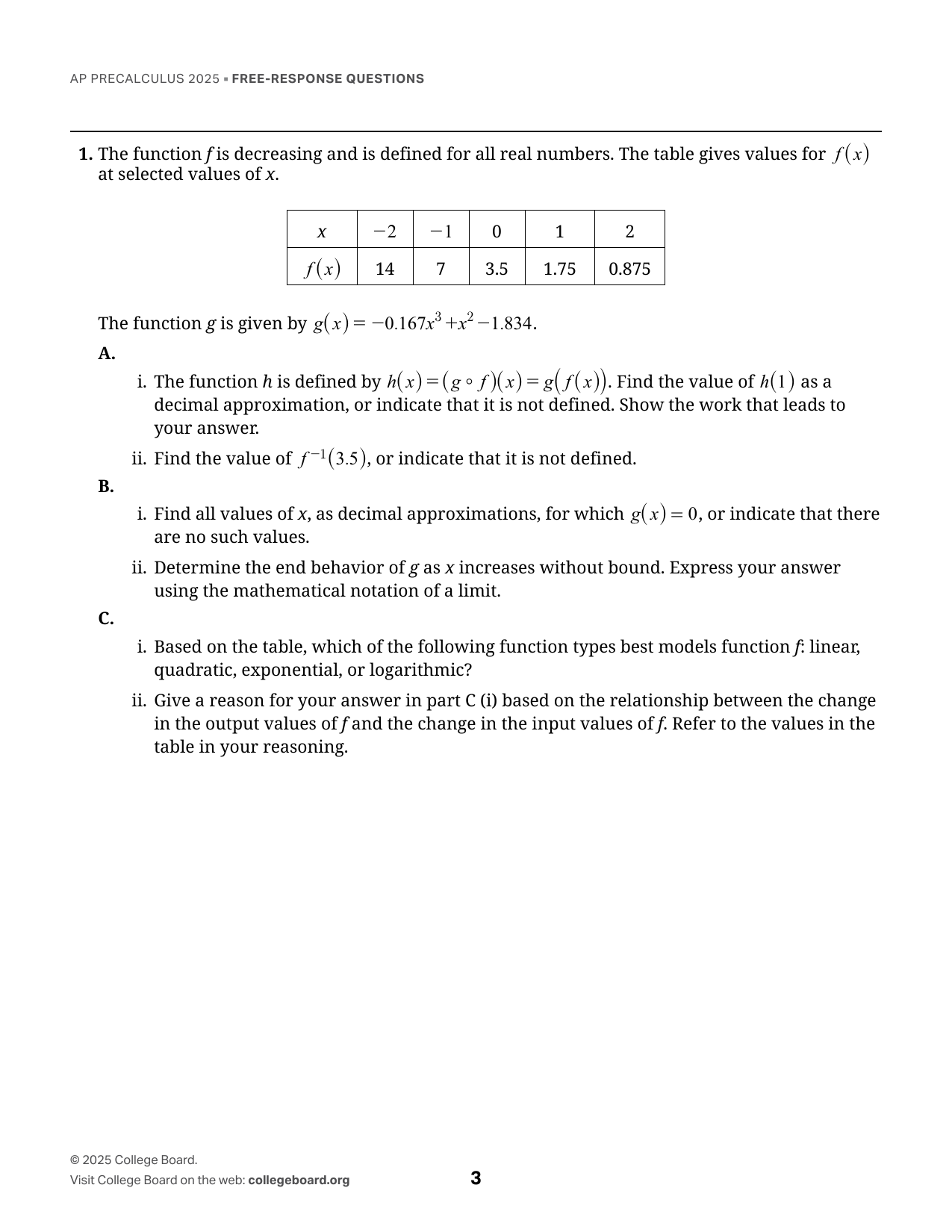
1. The function f is decreasing and is defined for all real numbers. The table gives values for f(x) at selected values of x. | x | -2 | -1 | 0 | 1 | 2 | |---|---:|---:|---:|---:|---:| | f(x) | 14 | 7 | 3.5 | 1.75 | 0.875 | The function g is given by g(x) = −0.167x³ + x² − 1.834. A. i. The function h is defined by h(x) = (g ∘ f)(x) = g(f(x)). Find the value of h(1) as a decimal approximation, or indicate that it is not defined. Show the work that leads to your answer. ii. Find the value of f⁻¹(3.5), or indicate that it is not defined. B. i. Find all values of x, as decimal approximations, for which g(x) = 0, or indicate that there are no such values. ii. Determine the end behavior of g as x increases without bound. Express your answer using the mathematical notation of a limit. C. i. Based on the table, which of the following function types best models function f: linear, quadratic, exponential, or logarithmic? ii. Give a reason for your answer in part C (i) based on the relationship between the change in the output values of f and the change in the input values of f. Refer to the values in the table in your reasoning.
Draw, drag, resize. Advanced coordinates are available if needed.
2. A musician released a new song on a streaming service. A streaming service is an online entertainment source that allows users to play music on their computers and mobile devices. Several months later, the musician began using an app (at time t = 0) that counts the total number of plays for the song since its release. A “play” is a single stream of the song on the streaming service. The table gives the total number of plays, in thousands, for selected times t months after the musician began using the app. At t = 0, the total number of plays was 25 thousand. At t = 2, the total number of plays was 30 thousand. At t = 4, the total number of plays was 34 thousand. | Months after the musician began using the app | 0 | 2 | 4 | |---|---:|---:|---:| | Total number of plays for the song since its release (thousands) | 25 | 30 | 34 | The total number of plays, in thousands, for the song since its release can be modeled by the function D given by D(t) = at² + bt + c, where D(t) is the total number of plays, in thousands, for the song since its release, and t is the number of months after the musician began using the app. A. i. Use the given data to write three equations that can be used to find the values for constants a, b, and c in the expression for D(t). ii. Find the values for a, b, and c as decimal approximations. B. i. Use the given data to find the average rate of change of the total number of plays for the song, in thousands per month, from t = 0 to t = 4 months. Express your answer as a decimal approximation. Show the computations that lead to your answer. ii. Use the average rate of change found in part B (i) to estimate the total number of plays for the song, in thousands, for t = 1.5 months. Show the work that leads to your answer. iii. Let A_t represent the estimate of the total number of plays for the song, in thousands, using the average rate of change found in part B (i). For A_1.5 found in part B (ii), it can be shown that A_1.5 < D(1.5). Explain why, in general, A_t < D(t) for all t, where 0 < t < 4. Your explanation should include a reference to the graph of D and its relationship to A_t. C. The quadratic function model D has exactly one absolute minimum or one absolute maximum. That minimum or maximum can be used to determine a domain restriction for D. Based on the context of the problem, explain how that minimum or maximum can be used to determine a boundary for the domain of D.
Draw, drag, resize. Advanced coordinates are available if needed.
3. For a guitar to make a sound, the strings need to vibrate, or move up and down or back and forth, in a motion that can be modeled by a periodic function. At time t = 0 seconds, point X on one vibrating guitar string starts at its highest position, 2 millimeters above its resting position. Then it passes through its resting position and moves to its lowest position, 2 millimeters below its resting position. Point X then passes through its resting position and returns to 2 millimeters above its resting position. This motion occurs 200 times in 1 second. The sinusoidal function h models how far point X is from its resting position, in millimeters, as a function of time t, in seconds. A positive value of h(t) indicates the point is above the resting position; a negative value of h(t) indicates the point is below the resting position. A. The graph of h and its dashed midline for two full cycles is shown. Five points, F, G, J, K, and P, are labelled on the graph. No scale is indicated, and no axes are presented. Determine possible coordinates (t, h(t)) for the five points: F, G, J, K, and P. [Graph shown: a sinusoidal graph for two full cycles with a dashed midline and points F, G, J, K, and P labelled.] B. The function h can be written in the form h(t) = a sin(b(t + c)) + d. Find values of constants a, b, c, and d. C. Refer to the graph of h in part A. The t-coordinate of G is t₁, and the t-coordinate of J is t₂. i. On the interval (t₁, t₂), which of the following is true about h? a. h is positive and increasing. b. h is positive and decreasing. c. h is negative and increasing. d. h is negative and decreasing. ii. On the interval (t₁, t₂), describe the concavity of the graph of h and determine whether the rate of change of h is increasing or decreasing.
Draw, drag, resize. Advanced coordinates are available if needed.
4. Directions: • Unless otherwise specified, the domain of a function f is assumed to be the set of all real numbers x for which f(x) is a real number. Angle measures for trigonometric functions are assumed to be in radians. • Solutions to equations must be real numbers. Determine the exact value of any expression that can be obtained without a calculator. For example, log₂8, cos(π/2), and sin⁻¹(1) can be evaluated without a calculator. • Unless otherwise specified, combine terms using algebraic methods and rules for exponents and logarithms, where applicable. For example, 2x + 3x, 5²·5³, x⁵/x², and ln 3 + ln 5 should be rewritten in equivalent forms. • For each part of the question, show the work that leads to your answers. A. The functions g and h are given by g(x) = 2 log₃ x h(x) = 4 cos² x i. Solve g(x) = 4 for values of x in the domain of g. ii. Solve h(x) = 3 for values of x in the interval [0, π/2). B. The functions j and k are given by j(x) = log₂ x + 3 log₂ 2 k(x) = 6/[tan x(csc² x − 1)] i. Rewrite j(x) as a single logarithm base 2 without negative exponents in any part of the expression. Your result should be of the form log₂(expression). ii. Rewrite k(x) as an expression in which tan x appears exactly once and no other trigonometric functions are involved. C. The function m is given by m(x) = e^(2x) − e^x − 12. Find all input values in the domain of m that yield an output value of 0.
Draw, drag, resize. Advanced coordinates are available if needed.
This material is the intellectual property of College Board, is not owned by GradeThis, and is shown here for ease of use and demonstration purposes.